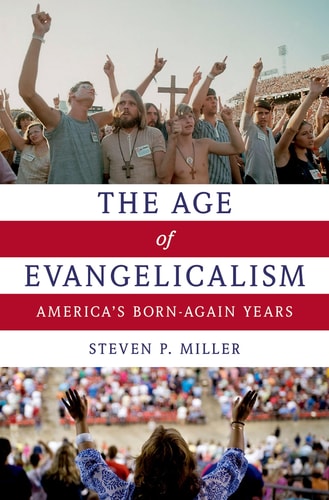
The Age of Evangelicalism: America's Born-Again Years
0
0
As an Amazon Associate and affiliate partner, Menrva Books earns from qualifying purchases. Learn more
Author Description
At the start of the twenty-first century, America was awash in a sea of evangelical talk. The Purpose Driven Life. Joel Osteen. The Left Behind novels. George W. Bush. Evangelicalism had become so powerful and pervasive that political scientist Alan Wolfe wrote of "a sense in which we are all evangelicals now."Steven P. Miller offers a dramatically different perspective: the Bush years, he argues, did not mark the pinnacle of evangelical influence, but rather the beginning of its decline. The Age of Evangelicalism chronicles the place and meaning of evangelical Christianity in America since 1970, a period Miller defines as America's "born-again years." This was a time of evangelical scares, born-again spectacles, and battles over faith in the public square. From the Jesus chic of the 1970s to the satanism panic of the 1980s, the culture wars of the 1990s, and the faith-based vogue of the early 2000s, evangelicalism expanded beyond churches and entered the mainstream in ways both subtly and obviously influential.Born-again Christianity permeated nearly every area of American life. It was broad enough to encompass Hal Lindsey's doomsday prophecies and Marabel Morgan's sex advice, Jerry Falwell and Jimmy Carter. It made an unlikely convert of Bob Dylan and an unlikely president of a divorced Hollywood actor. As Miller shows, evangelicalism influenced not only its devotees but its many detractors: religious conservatives, secular liberals, and just about everyone in between. The Age of Evangelicalism contained multitudes: it was the age of Christian hippies and the "silent majority," of Footloose and The Passion of the Christ, of Tammy Faye Bakker the disgraced televangelist and Tammy Faye Messner the gay icon. Barack Obama was as much a part of it as Billy Graham.The Age of Evangelicalism tells the captivating story of how born-again Christianity shaped the cultural and political climate in which millions Americans came to terms with their times.
Menrva's Summary
THE THESIS
Does the era of George W. Bush represent the zenith of American evangelical influence, or does it signify the onset of its institutional and cultural decline? Steven P. Miller, a historian of American religion, argues that the period from 1970 to the early 2000s—termed the "born-again years"—saw evangelicalism permeate the mainstream, only to reach a point of saturation that ultimately weakened its political and social cohesion. By analyzing the intersection of popular culture, political shifts, and religious identity, Miller posits that the movement's expansion into the secular sphere fundamentally altered its character and long-term viability.
THE SCOPE MAP
What You Will Find
- Historical analysis of the "born-again years" spanning from 1970 to the early 2000s.
- Examination of evangelical influence on media, including film, literature, and music.
- Case studies on political figures such as Jimmy Carter, Ronald Reagan, and George W. Bush.
- Exploration of cultural phenomena like the satanism panic, the Jesus movement, and the culture wars.
Scope Limits
- The text does not provide an exhaustive theological history of evangelical denominations.
- It does not focus on global evangelical movements outside of the United States.
THE AUTHORITY PERSPECTIVE
Scholars and historians frequently identify this work as a significant contribution to the study of American religious history and its intersection with modern politics. Readers often note the accessible prose style, which balances academic rigor with a broad overview of cultural trends during the late twentieth century.
Page Count:
240
Publication Date:
2016-11-01
Publisher:
Oxford University Press
ISBN-10:
0190636696
ISBN-13:
9780190636692
Politics
History
Religion
Sociology
Cultural History
American Studies
Community Tags
Similar Books