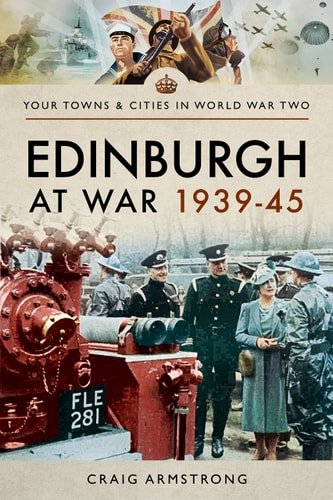
Edinburgh at War 1939-45
0
0
As an Amazon Associate and affiliate partner, Menrva Books earns from qualifying purchases. Learn more
Author Description
Scotland was of grave strategic importance during the war because of its geographical position and its capital was the location of a significant number of important military and civil organizations. Edinburgh Castle became the HQ of the Scottish Home Forces whilst the Forth was a vitally important port and was heavily protected even before the start of the war. Its importance was marked by its attracting the first air raid of the war on mainland Britain when a force of German bombers was sent to attack naval shipping in the Forth on 16th October 1939. The raid was intercepted by the RAF which shot down at least two bombers and the entire action was witnessed by many civilians on the ground. The raid also caused the first civilian casualties when two women were injured in Edinburgh and two men machine-gunned in Portobello. Thousands lined the streets days later for the funeral of two of the Luftwaffe airmen. No member of the population of Edinburgh escaped the war, whether it was the huge numbers of men and women from the area who came forward for service in the military or in roles such as the Home Guard, ARP services, nursing, working in vital war industries, struggling to maintain a household under strict rationing and the stresses of wartime life, or children evacuated from the city to the rural areas of Scotland to escape the expected bombing campaign (even though the Archbishop of Edinburgh called for their return if there was insufficient provision of religious instruction in reception areas). Edinburgh was also home to a sizable Italian community which was badly affected by internment and the subsequent tight restrictions on movement and civil rights. The Italian community was also subjected to violent attacks when rioting mobs attacked Italian owned business throughout the city (although one family business was spared because one of the sons was known as a fanatical supporter of Hibs). Edinburgh at War 1939-1945 poignantly commemorates the efforts a
Menrva's Summary
THE THESIS
This book investigates the multifaceted impact of World War II on the city of Edinburgh and its inhabitants. Craig Armstrong's work details Edinburgh's strategic importance during the war, highlighting its role as a hub for military and civil organizations, with Edinburgh Castle serving as the HQ for Scottish Home Forces and the Forth estuary as a vital, protected port. The narrative recounts the first air raid on mainland Britain on October 16, 1939, detailing the RAF's interception and the resulting civilian casualties, as well as the city's collective response. It explores the experiences of all residents, from those in military service and war industries to children evacuated from the city and the Italian community affected by internment and civil unrest.
THE SCOPE MAP
- The strategic military and civil importance of Edinburgh during WWII.
- Details of the first air raid on mainland Britain and its consequences.
- The diverse experiences of Edinburgh's population, including military personnel, home front workers, evacuated children, and the Italian community.
- The impact of rationing and wartime life on households.
- The role of Edinburgh Castle and the Forth estuary in wartime defense.
THE AUTHORITY PERSPECTIVE
This book is likely to be regarded as a detailed and comprehensive account of Edinburgh's experience during World War II. The provided description suggests a focus on the human element of the conflict, detailing the varied impacts on different segments of the city's population. It appears to offer a thorough exploration of both the strategic military significance and the personal struggles faced by residents, making it a valuable resource for those interested in Scottish history and the home front during wartime.
Page Count:
216
Publication Date:
2018-01-01
Publisher:
Pen & Sword Books Limited
ISBN-10:
1473879639
ISBN-13:
9781473879638
History
Non-Fiction
Military History
Scottish History
Community Tags
Other Editions(2)

Similar Books
Reader Comments
Share Your Thoughts
No comments yet. Be the first to share your thoughts!