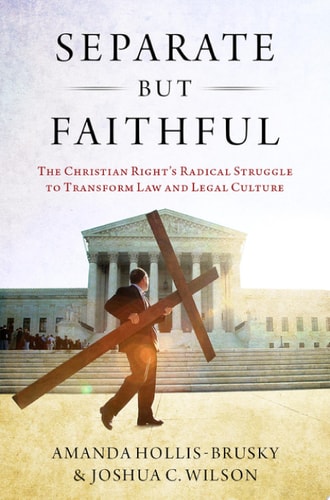
Separate but Faithful: The Christian Right's Radical Struggle to Transform Law and Legal Culture
0
0
As an Amazon Associate and affiliate partner, Menrva Books earns from qualifying purchases. Learn more
Author Description
Fueled by grassroots activism and a growing collection of formal political organizations, the Christian Right became an enormously influential force in American law and politics in the 1980s and 90s. While this vocal and visible political movement has long voiced grave concerns about the Supreme Court and cases such as Roe v. Wade, they weren't able to effectively enter the courtroom in a serious and sustained way until recently. During the pivot from the 20th to the 21st century, a small constellation of high-profile Christian Right leaders began to address this imbalance by investing in an array of institutions aimed at radically transforming American law and legal culture.In Separate But Faithful, Amanda Hollis-Brusky and Joshua C. Wilson provide an in-depth examination of these efforts, including their causes, contours and consequences. Drawing on an impressive amount of original data from a variety of sources, they look at the conditions that gave rise to a set of distinctly "Christian Worldview" law schools and legal institutions. Further, Hollis-Brusky and Wilson analyze their institutional missions and cultural makeup and evaluate their transformative impacts on law and legal culture to date. In doing so, they find that this movement, while struggling to influence the legal and political mainstream, has succeeded in establishing a Christian conservative beacon of resistance; a separate but faithful space from which to incrementally challenge the dominant legal culture.Both a compelling narrative of the rise of Christian Right lawyers and a trenchant analysis of how institutional networks fuel the growth of social movements, Separate But Faithful challenges the dominant perspectives of the politics of law in contemporary America.
Menrva's Summary
THE THESIS
How did the Christian Right successfully transition from grassroots political activism to establishing a sustained, institutional presence within the American legal system? Amanda Hollis-Brusky and Joshua C. Wilson, both scholars of law and politics, utilize a rigorous institutionalist framework to examine the development of conservative Christian legal networks. By analyzing the creation of specialized law schools and advocacy organizations, the authors argue that this movement shifted its strategy from external protest to internal systemic influence, creating a parallel legal culture designed to challenge secular norms from within.
THE SCOPE MAP
What You Will Find
- Analysis of the institutional infrastructure of Christian Right legal organizations.
- Examination of the rise of "Christian Worldview" law schools and their pedagogical missions.
- Evaluation of the long-term impact of these institutions on judicial appointments and legal discourse.
- Original data sets derived from interviews and organizational archives.
Scope Limits
- The study focuses primarily on the institutional development within the United States and does not cover international religious legal movements.
- The analysis does not provide a comprehensive history of the entire Christian Right movement, focusing specifically on the legal and judicial sector.
THE AUTHORITY PERSPECTIVE
Experts in political science and legal studies recognize this work as a significant contribution to understanding the institutionalization of social movements. Readers frequently note the academic density of the prose, which provides a detailed, evidence-based account of how conservative legal networks operate in contemporary America.
Page Count:
309
Publication Date:
2020-01-01
Publisher:
Oxford University Press
ISBN-10:
0190637285
ISBN-13:
9780190637286
Professional Career & Trade
Religion and Politics
American History
Sociology
Law
Christian Right
Community Tags
Similar Books