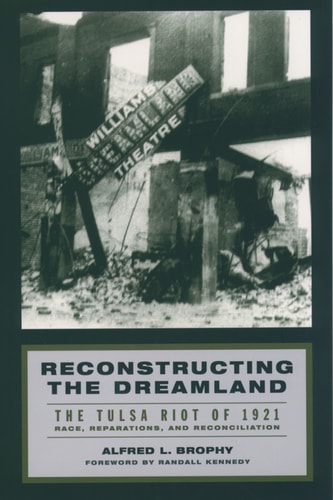
Reconstructing the Dreamland: The Tulsa Riot of 1921: Race, Reparations, and Reconciliation
0
0
As an Amazon Associate and affiliate partner, Menrva Books earns from qualifying purchases. Learn more
Author Description
The 1921 Tulsa Race Riot was the country's bloodiest civil disturbance of the century. Leaving perhaps 150 dead, 30 city blocks burned to the ground, and more than a thousand families homeless, the riot represented an unprecedented breakdown of the rule of law. It reduced the prosperous black community of Greenwood, Oklahoma, to rubble. In Reconstructing the Dreamland, Alfred Brophy draws on his own extensive research into contemporary accounts and court documents to chronicle this devastating riot, showing how and why the rule of law quickly eroded. Brophy offers a gut-wrenching portrait of mob violence and racism run amok, both on the night of the riot and the morning after, when a coordinated sunrise attack, accompanied by airplanes, stormed through Greenwood, torching and looting the community. Equally important, he shows how the city government and police not only permitted the looting, shootings, and burning of Greenwood, but actively participated in it. The police department, fearing that Greenwood was erupting into a "negro uprising" (which Brophy shows was not the case), deputized white citizens haphazardly, gave out guns and badges with little background check, or sent men to hardware stores to arm themselves. Likewise, the Tulsa-based units of the National Guard acted unconstitutionally, arresting every black resident they could find, leaving Greenwood property vulnerable to the white mob, special deputies, and police that followed behind and burned it. Brophy's revelations and stark narrative of the events of 1921 bring to life an incidence of racial violence that until recently lay mostly forgotten. Reconstructing the Dreamland concludes with a discussion of reparations for victims of the riot. That case has implications for other reparations movements, including reparations for slavery.
Menrva's Summary
THE THESIS
This work investigates the legal and social collapse that facilitated the 1921 Tulsa Race Riot and evaluates the subsequent arguments for reparations for the affected community. Alfred L. Brophy, a legal scholar, utilizes extensive archival research, court documents, and contemporary accounts to reconstruct the events in Greenwood, Oklahoma. He argues that the destruction was not merely a spontaneous act of mob violence but a coordinated failure of the rule of law, involving active participation from city government, police, and the National Guard. The text provides a framework for understanding how systemic racism and institutional complicity enabled the erasure of a prosperous black district.
THE SCOPE MAP
What You Will Find
- Detailed analysis of the 1921 Tulsa Race Riot events and the destruction of the Greenwood district.
- Examination of the legal failures and unconstitutional actions taken by local law enforcement and the National Guard.
- A comprehensive discussion regarding the historical and legal basis for reparations for victims of racial violence.
Scope Limits
- The book focuses primarily on the legal and historical context of the Tulsa event rather than providing a broad sociological survey of all American race riots.
- It does not offer a definitive policy manual for modern reparations but rather explores the legal precedents and arguments surrounding the topic.
THE AUTHORITY PERSPECTIVE
Scholars and historians recognize this text as a foundational resource for understanding the legal dimensions of the Tulsa Race Riot. Readers frequently note the academic rigor of the prose and the author's ability to synthesize complex legal history into a coherent narrative.
Page Count:
207
Publication Date:
2003-01-01
Publisher:
Oxford University Press
ISBN-10:
0190289694
ISBN-13:
9780190289690
History
Sociology
United States
African American
American History
Race Relations
Professional Career & Trade
Ethnic Studies
Law
Community Tags
Other Editions(2)
Similar Books

Reader Comments
Share Your Thoughts
No comments yet. Be the first to share your thoughts!