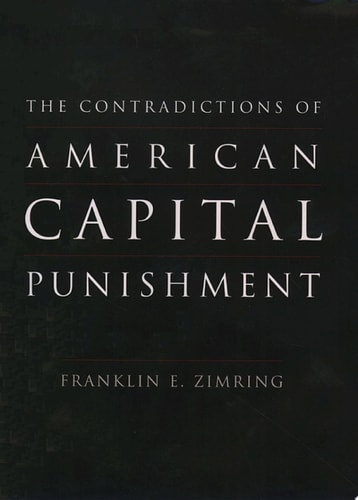
The Contradictions of American Capital Punishment (Studies in Crime and Public Policy)
0
0
As an Amazon Associate and affiliate partner, Menrva Books earns from qualifying purchases. Learn more
Author Description
Why does the United States continue to employ the death penalty when fifty other developed democracies have abolished it? Why does capital punishment become more problematic each year? How can the death penalty conflict be resolved? In The Contradictions of American Capital Punishment, Frank Zimring reveals that the seemingly insoluble turmoil surrounding the death penalty reflects a deep and long-standing division in American values, a division that he predicts will soon bring about the end of capital punishment in our country. On the one hand, execution would seem to violate our nation's highest legal principles of fairness and due process. It sets us increasingly apart from our allies and indeed is regarded by European nations as a barbaric and particularly egregious form of American exceptionalism. On the other hand, the death penalty represents a deeply held American belief in violent social justice that sees the hangman as an agent of local control and safeguard of community values. Zimring uncovers the most troubling symptom of this attraction to vigilante justice in the lynch mob. He shows that the great majority of executions in recent decades have occurred in precisely those Southern states where lynchings were most common a hundred years ago. It is this legacy, Zimring suggests, that constitutes both the distinctive appeal of the death penalty in the United States and one of the most compelling reasons for abolishing it. Impeccably researched and engagingly written, Contradictions in American Capital Punishment casts a clear new light on America's long and troubled embrace of the death penalty.
Menrva's Summary
THE THESIS
This book investigates the paradox of why the United States maintains capital punishment despite its status as a developed democracy and its inherent conflicts with national legal principles. Franklin E. Zimring, a professor of law and expert in criminal justice, utilizes historical data and sociological analysis to argue that the death penalty persists as a manifestation of a specific American cultural legacy regarding violent social justice. He posits that this internal value conflict, rooted in historical patterns of vigilante justice, is the primary driver of the current legal and moral instability surrounding executions.
THE SCOPE MAP
What You Will Find
- Comparative analysis of death penalty policies between the United States and other developed democracies.
- Historical correlation data linking modern execution rates to historical lynching patterns in the American South.
- A framework for understanding the death penalty as a tool of local control versus national due process.
Scope Limits
- The text does not provide a comprehensive legal manual for death penalty defense or appellate procedures.
- It does not focus on the psychological profiles of individual death row inmates.
THE AUTHORITY PERSPECTIVE
Scholars and legal experts frequently cite this work as a foundational text for understanding the sociological underpinnings of American capital punishment. Readers often note the academic rigor of the prose while appreciating the clarity with which the author connects historical regional violence to contemporary policy debates.
Page Count:
272
Publication Date:
2004-01-01
Publisher:
Oxford University Press
ISBN-10:
0190292377
ISBN-13:
9780190292379
Professional Career & Trade
Sociology
Law
American History
Public Policy
Criminology
Community Tags
Similar Books