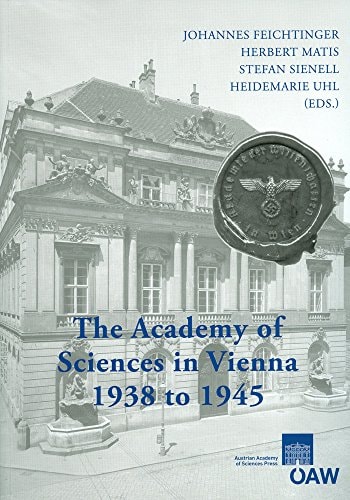
The Academy of Sciences in Vienna 1938 to 1945
0
0
As an Amazon Associate and affiliate partner, Menrva Books earns from qualifying purchases. Learn more
Author Description
In 2013, the Academy is using the 75th anniversary of the "Anschluss" in March 1938 as an occasion to present an exhibition and to publish a catalog investigating the reactions of the Academy to the Nazi power takeover, the Academy's involvement in the Nazi domination apparatus, and the impact this had on the postwar period. New research findings allow a profound insight into the personnel and institutional structure of the Academy as well as its scientific focus during the Nazi era. The "Anschluss" of Austria by the National Socialist German Reich in March 1938 marked a profound turning point for the Academy of Sciences in Vienna. With the Nazis' seizure of power, Academy members and staff members were forced to leave for political and "racial" reasons. They were persecuted and expelled; they died in Nazi concentration camps. Organizations like the Institute for Radium Research, the Vivarium, and the Phonogram Archive lost their key research personnel; worldwide pioneering research programs and international research collaborations were broken off. Under the Academy's new Nazi leadership, the learned society's autonomy was reduced and research projects in the support of Nazi ideology were carried out. The year 1945 was not a "zero hour." In addition to breaks, there were also continuities in the research institutes as well as the association of scholars. In dealing with Nazism, the Academy took an ambivalent stance: In the early postwar period, the membership of former Nazis was provisionally suspended. A few years later - pursuant to the Amnesty Law of 1948 - practically all former Nazi party members, even high-ranking officials, were re-admitted as members.
Menrva's Summary
THE THESIS
This book investigates the profound impact of the Nazi regime on the Academy of Sciences in Vienna between 1938 and 1945. The study examines the Academy's response to the Nazi power takeover, its integration into the Nazi apparatus, and the lasting consequences for the postwar period, drawing on new research to illuminate the personnel, institutional structure, and scientific focus during this era. It details the forced departures, persecution, and deaths of Academy members and staff due to political and racial reasons, the disruption of pioneering research programs, and the erosion of the society's autonomy under Nazi leadership. The work also addresses the complex continuities and ambivalent stance the Academy took in dealing with its past, particularly regarding the re-admission of former Nazi members after the war.
THE SCOPE MAP
- Analysis of the Academy's institutional and personnel changes following the 1938 "Anschluss".
- Examination of the persecution and expulsion of members and staff based on political and "racial" grounds.
- Impact on specific research institutes like the Institute for Radium Research, the Vivarium, and the Phonogram Archive.
- The role of the Academy in supporting Nazi ideology through research projects.
- Exploration of continuities in research and scholarly associations from the Nazi era into the postwar period.
- The Academy's ambivalent approach to dealing with former Nazi members in the postwar era, including suspensions and re-admissions.
THE AUTHORITY PERSPECTIVE
This comprehensive historical account, stemming from research for a 2013 exhibition, offers a detailed examination of a significant academic institution during a tumultuous period. The work is grounded in new research findings, providing specific insights into the Academy's internal dynamics and its complex relationship with the Nazi regime. It addresses both the ruptures caused by persecution and ideological alignment, and the continuities that persisted into the postwar era, offering a nuanced perspective on the institution's engagement with its past. The research highlights the challenges of confronting historical complicity and the subsequent processes of reconciliation and re-integration.
Page Count:
270
Publication Date:
2014-01-01
Publisher:
Austrian Academy of Sciences Press
ISBN-10:
370017537X
ISBN-13:
9783700175377
History
Non-Fiction
Academic History
Austrian History
Community Tags
Similar Books