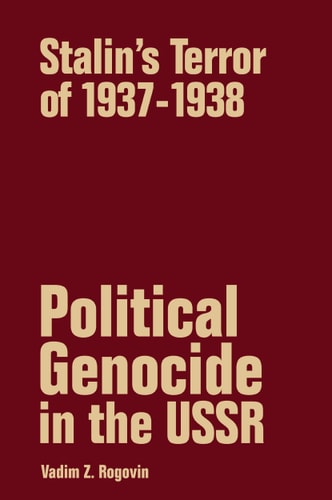
Stalin's Terror of 1937-1938: Political Genocide in the USSR
0
0
As an Amazon Associate and affiliate partner, Menrva Books earns from qualifying purchases. Learn more
Author Description
This volume examines the bloodiest period of the Stalinist repression of political opposition in the Soviet Union, debunking the myth that the Great Purges were merely the product of Stalin's paranoia and had no overriding political logic. Through a meticulous examination of original sources, including archival documents only made available for research in the 1990s, Professor Vadim Rogovin argues that the ferocity of the mass repression was directly proportional to the intensity of resistance to Stalin within the Communist Party of the Soviet Union (CPSU), particularly the opposition inspired by and associated with the exiled Bolshevik leader Leon Trotsky. Far from Trotsky being a politically isolated figure, as both Stalinist and anti-communist historians have claimed, there was substantial sympathy for his criticism of the Stalin regime in the ranks and even in the leadership of the CPSU, and support for his demands for inner-party democracy, greater social equality and an international orientation to the Bolshevik goal of world revolution. It was this political fact, as Rogovin demonstrates, that accounts for the purge reaching so deeply into the party apparatus, the military, the Komsomol youth movement, and the broader layers of the population. Rogovin bases his analysis on scrupulous research, quoting from newly translated or unpublished documents, including memoirs, meeting minutes, newspaper articles and trial transcripts. He documents the reaction of different social layers to the purges, including workers, peasants, non-party intellectuals and the CPSU rank-and-file. This book includes rarely published photographs of the prison camps, documenting the lives of those labeled by Stalin;enemies of the people. Chronologically, this volume takes up where its predecessor, 1937: Stalin's Year of Terror, left off, with the June 1937 plenum of the Central Committee that followed the purging of the Soviet military command and the execution of Marshal Tukhachevsky a
Menrva's Summary
THE THESIS
This volume investigates the political logic and motivations behind the most brutal phase of Stalin's purges in 1937-1938, challenging the notion that these events were solely the product of Stalin's paranoia. Professor Vadim Rogovin, drawing on newly accessible archival documents from the 1990s, argues that the intensity of the mass repression was a direct response to the level of resistance encountered within the Communist Party of the Soviet Union (CPSU), particularly from elements inspired by Leon Trotsky. Rogovin posits that significant sympathy for Trotsky's criticisms of Stalin's regime, and his calls for inner-party democracy and social equality, existed within the party's ranks and leadership. This underlying political reality, he contends, explains the pervasive reach of the purges across the party apparatus, military, youth organizations, and the general population.
THE SCOPE MAP
- Analysis of the 1937-1938 period of Stalin's repression, focusing on political motivations.
- Debunks the myth that the Great Purges were solely due to Stalin's paranoia.
- Utilizes original sources, including archival documents made available in the 1990s.
- Examines the intensity of resistance to Stalin within the CPSU, particularly opposition inspired by Leon Trotsky.
- Documents the reaction of various social strata to the purges, including workers, peasants, and intellectuals.
- Includes rarely published photographs of prison camps.
THE AUTHORITY PERSPECTIVE
This volume is regarded as a meticulous and deeply researched examination of a critical period in Soviet history. Professor Rogovin's argument, that the scale of the purges was directly proportional to internal resistance, is supported by extensive use of newly available archival materials. The work is noted for its detailed analysis of the political dynamics within the Communist Party and its impact on various social layers. It provides a counter-narrative to simpler explanations of Stalin's terror, emphasizing the political logic behind the repression.
Page Count:
513
Publication Date:
2009-07-13
Publisher:
Mehring Books, Incorporated
ISBN-10:
1893638081
ISBN-13:
9781893638082
Non-Fiction
Politics
History
Soviet Union
Stalinism
Community Tags
Similar Books