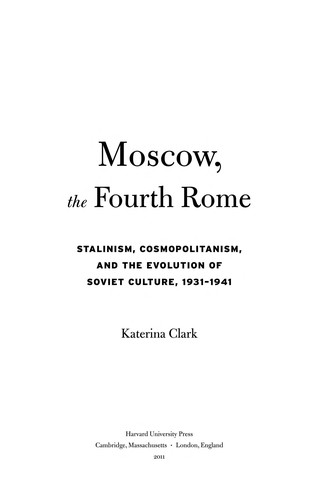
Moscow, the Fourth Rome
0
0
As an Amazon Associate and affiliate partner, Menrva Books earns from qualifying purchases. Learn more
Author Description
In the early sixteenth century, the monk Filofei proclaimed Moscow the 'Third Rome.' By the 1930s, intellectuals and artists all over the world thought of Moscow as a mecca of secular enlightenment. In Moscow, the Fourth Rome, Katerina Clark shows how Soviet officials and intellectuals, in seeking to capture the imagination of leftist and anti-fascist intellectuals throughout the world, sought to establish their capital as the cosmopolitan center of a post-Christian confederation and to rebuild it to become a beacon for the rest of the world. Clark provides an interpretative cultural history of the city during the crucial 1930s, the decade of the Great Purge. She draws on the work of intellectuals such as Sergei Eisenstein, Sergei Tretiakov, Mikhail Koltsov, and Ilya Ehrenburg to shed light on the singular Zeitgeist of that most Stalinist of periods. In her account, the decade emerges as an important moment in the prehistory of key concepts in literary and cultural studies today--transnationalism, cosmopolitanism, and world literature. By bringing to light neglected antecedents, she provides a new polemical and political context for understanding canonical works of writers such as Brecht, Benjamin, Lukacs, and Bakhtin. Moscow, the Fourth Rome broadens the framework that has traditionally constrained cultural histories of Stalinist Russia to include considerable interaction with Western intellectuals and trends. Its integration of the understudied international dimension into the interpretation of Soviet culture remedies misunderstandings of the world-historical significance of Moscow under Stalin.--Jacket.
Menrva's Summary
THE THESIS
This book investigates how Soviet officials and intellectuals in the 1930s sought to establish Moscow as a cosmopolitan center of a post-Christian confederation, aiming to rebuild it as a beacon for the world. Katerina Clark provides an interpretative cultural history of the city during the crucial decade of the Great Purge, drawing on the work of intellectuals such as Sergei Eisenstein, Sergei Tretiakov, Mikhail Koltsov, and Ilya Ehrenburg. The book examines the singular Zeitgeist of the Stalinist period, revealing it as an important moment in the prehistory of key concepts in literary and cultural studies like transnationalism, cosmopolitanism, and world literature. By integrating the understudied international dimension into the interpretation of Soviet culture, it remedies misunderstandings of Moscow's world-historical significance under Stalin.
THE SCOPE MAP
- An interpretative cultural history of Moscow during the 1930s, the decade of the Great Purge.
- Analysis of how Soviet officials and intellectuals positioned Moscow as a cosmopolitan center and a beacon for the world.
- Exploration of the influence of intellectuals such as Sergei Eisenstein, Sergei Tretiakov, Mikhail Koltsov, and Ilya Ehrenburg.
- Examination of the Zeitgeist of the Stalinist period and its connection to concepts like transnationalism, cosmopolitanism, and world literature.
- Discussion of the interaction between Soviet culture and Western intellectuals and trends.
- A new political and polemical context for understanding canonical works of writers such as Brecht, Benjamin, Lukacs, and Bakhtin.
THE AUTHORITY PERSPECTIVE
The book is regarded as a significant contribution to the understanding of Stalinist Russia's cultural history, particularly its international dimensions. It is noted for broadening the traditional framework by integrating interactions with Western intellectuals and trends, thereby remedying misunderstandings of Moscow's world-historical significance under Stalin. The work is praised for bringing to light neglected antecedents that provide a new context for understanding canonical literary and cultural studies concepts.
Page Count:
420
Publication Date:
2011-01-01
ISBN-10:
0674057872
ISBN-13:
9780674057876
History
Non-Fiction
Soviet Union
Transnationalism
Cultural History
Intellectual History
Stalinism
Community Tags
Similar Books