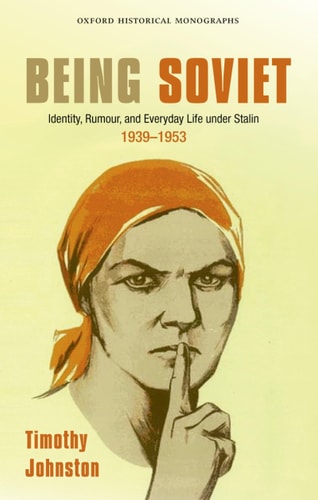
Being Soviet: Identity, Rumour, and Everyday Life under Stalin, 1939-53
0
0
As an Amazon Associate and affiliate partner, Menrva Books earns from qualifying purchases. Learn more
Author Description
Being Soviet adopts a refreshing and innovative approach to the crucial years between 1939 and 1953 in the USSR. It addresses two of the key recent debates concerning Stalinism: 'what was the logic and language of Soviet power?' and 'how did ordinary citizens relate to Soviet power?' In relation to the first debate, Timothy Johnston shifts the focus away from Russian nationalism onto Soviet identity which, in relation to the outside world, provided a powerful frame of reference in the late-Stalin years. 'Sovietness' is explored via the newspapers, films, plays, and popular music of the era.Johnston's most significant contribution lies in his novel answer to the question 'How did ordinary citizens relate to Soviet power?' He avoids the current Foucault-inspired emphasis on 'supporters' and 'resistors' of the regime. Instead, he argues that most Soviet citizens did not fit easily into either category. Their relationship with Soviet power was defined by a series of subtle 'tactics of the habitat' (Kotkin) that enabled them to stay fed, informed, and entertained in these difficult times. Being Soviet offers a rich and textured discussion of those everyday survival strategies via the rumours, jokes, hairstyles, music tastes, sexual relationships, and political campaigns of the era. Each chapter finishes by exploring what this everyday behaviour tells us about the collective mentalite of Stalin-era society.Being Soviet focuses on the place of Britain and America within Soviet identity; their evolution from wartime allies to Cold War enemies played a vital role in redefining what it meant to be Soviet in Stalin's last years.
Menrva's Summary
THE THESIS
This book investigates how ordinary Soviet citizens constructed their identities and navigated the complexities of daily life during the late-Stalinist period between 1939 and 1953. Timothy Johnston, a scholar of Soviet history, challenges binary interpretations of the era that categorize citizens strictly as either regime supporters or resistors. By analyzing a wide array of cultural artifacts and social behaviors, he argues that the Soviet population employed nuanced survival strategies to maintain their livelihoods and social standing within a rigid political framework.
THE SCOPE MAP
What You Will Find
- An analysis of Soviet identity formation through contemporary media including newspapers, films, plays, and popular music.
- Examination of the shifting geopolitical perceptions of Britain and America as the USSR transitioned from wartime alliance to Cold War hostility.
- A study of everyday survival tactics, including the role of rumors, jokes, and personal habits in navigating state power.
- An exploration of the collective mentalite of Stalin-era society through the lens of individual behavior and social interaction.
THE AUTHORITY PERSPECTIVE
Scholars and historians frequently cite this work for its departure from traditional top-down political analysis in favor of a bottom-up social history approach. Readers often note the academic density of the prose, which provides a rigorous examination of the cultural and social mechanisms that defined the late-Stalinist experience.
Page Count:
288
Publication Date:
2011-09-07
Publisher:
Oxford University Press
ISBN-10:
0199604037
ISBN-13:
9780199604036
History
Stalinism
Soviet Union
United States
Political History
Social History
Cultural History
National characteristics Russian
Community Tags
Similar Books