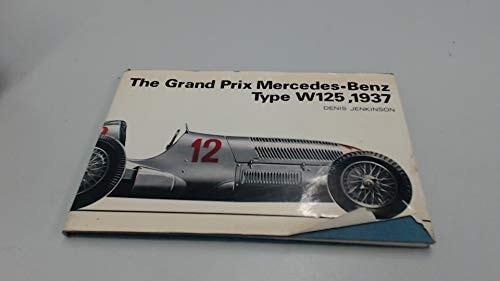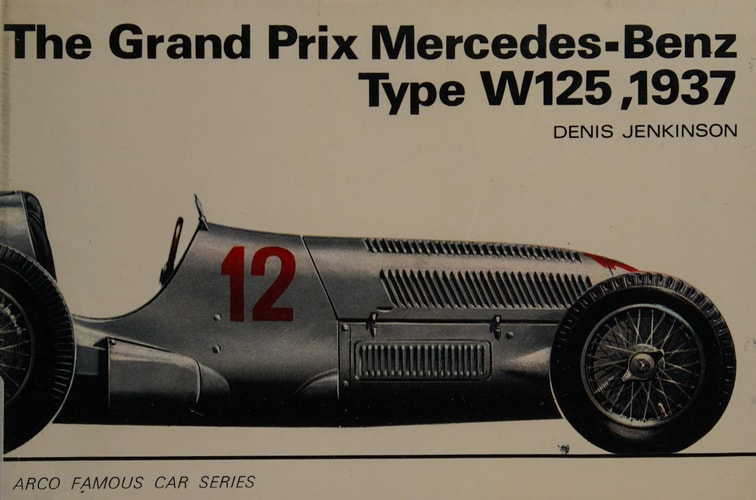
The Grand Prix Mercedes-Benz Type W125, 1937
0
0
As an Amazon Associate and affiliate partner, Menrva Books earns from qualifying purchases. Learn more
Author Description
The Mercedes-Benz W125 was a Grand Prix racing car designed by Rudolf Uhlenhaut to race during the 1937 Grand Prix season. The car was used by Rudolf Caracciola to win the 1937 European Championship and W125 drivers also finished in the second, third and fourth positions in the championship. The supercharged engine, with 8 cylinders in line (94.0 x 102.mm) and 5,662.85 cc (345.56 CID), attained an output of up to 595 horse power (444 kW) in race trim. The highest test bed power measured was 637 BHP (646 PS) at 5,800 rpm. It gave 245 BHP (248 PS) at a mere 2,000 rpm. In 1938, the engine capacity of supercharged Grand Prix cars was limited to 3000cc, and the W125 was replaced by the Mercedes-Benz W154. The W125 was considered the most powerful race car ever for about 3 decades, until large capacity US-built V8 engines in CanAm sportcars reached similar power in the mid 1960s. In Formula One racing itself, the figure was not exceeded until the early 1980s, with the appearance of turbo-charged engines in Formula One. The W125 reached race speeds of well over 300 km/h (190 mph) in 1937, especially on the AVUS in Berlin, equipped with a streamlined body.
Menrva's Summary
THE THESIS
The Mercedes-Benz W125 defined an era of Grand Prix racing with its unparalleled power and engineering. This book delves into the design and racing history of the W125, a car that dominated the 1937 Grand Prix season. Driven by legends like Rudolf Caracciola, it secured the European Championship and showcased the pinnacle of automotive engineering for its time. The text likely explores the technical specifications, performance data, and the competitive landscape that shaped its legacy.
THE SCOPE MAP
- Detailed technical specifications of the Mercedes-Benz W125.
- Analysis of the supercharged 8-cylinder engine and its power output.
- Racing history and achievements during the 1937 Grand Prix season.
- Comparison of the W125's power to later racing cars.
- Discussion of the W125's replacement by the W154 due to rule changes.
- Information on race speeds achieved, particularly with streamlined bodies.
THE AUTHORITY PERSPECTIVE
This book is likely regarded as a definitive technical and historical account of the Mercedes-Benz W125. Denis Jenkinson, a renowned motorsport journalist, provides an authoritative perspective on this iconic racing car. The detailed specifications and historical context suggest it appeals to enthusiasts of automotive engineering and Grand Prix history. Its focus on a specific, dominant vehicle from a pivotal era of motorsport positions it as a valuable reference for historians and fans alike.
Page Count:
75
Publication Date:
1970-01-01
Publisher:
Arco Publishing Company
ISBN-10:
0668023317
ISBN-13:
9780668023313
Non-Fiction
History
Engineering
Automotive History
Motorsport