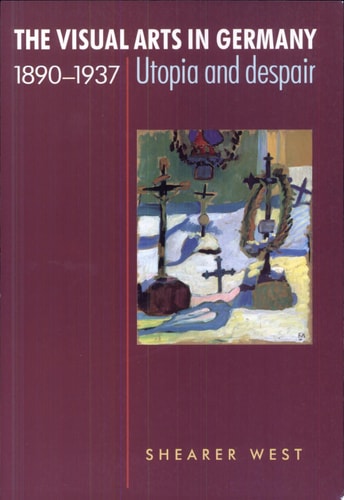
The Visual Arts in Germany, 1890-1937 Utopia and Despair
0
0
As an Amazon Associate and affiliate partner, Menrva Books earns from qualifying purchases. Learn more
Author Description
Shearer West introduces the visual arts in Germany from the early years of German unification until the beginning of the Second World War. Germany during this period was the site of key movements, including Secessionism, Die Brucke, Der Blaue Reiter, Expressionism, Bauhaus, Dada, and Neue Sachlichkeit. It was a time when artists of the stature of Klimt, Kirchner, Kandinsky, Marc, Macke, Beckmann, Schwitters, Ernst, Kollwitz, Grosz, Hoch, Heartfield, and Dix were all producing their best work. This book is more than just a survey of artists and movements; it brings a much-needed context to the analysis of not only painting, but sculpture, graphic art, design, and film and photography by relating them to a wider set of cultural and social issues that were specific to German modernism. West concentrates on the ways in which the production and reception of art interacted with--and were affected by--responses to unification, conflict between left and right political factions, gender concerns, contemporary philosophical and religious ideas, the growth of cities, and the increasing importance of mass culture. [Well written and accessible, this book will be essential reading for students of art history and German cultural history.]
Menrva's Summary
THE THESIS
The Visual Arts in Germany, 1890-1937: Utopia and Despair examines the dynamic and often tumultuous landscape of German visual arts during a period of profound social, political, and cultural transformation. Shearer West analyzes how artistic production, encompassing painting, sculpture, graphic art, design, film, and photography, was deeply intertwined with the era's defining issues. The book explores the interplay between artistic movements like Secessionism, Expressionism, Bauhaus, and Dada, and the broader societal forces of unification, political polarization, gender concerns, philosophical shifts, urbanization, and the rise of mass culture.
THE SCOPE MAP
- Coverage of key German art movements including Secessionism, Die Brucke, Der Blaue Reiter, Expressionism, Bauhaus, Dada, and Neue Sachlichkeit.
- Analysis of prominent artists such as Klimt, Kirchner, Kandinsky, Marc, Macke, Beckmann, Schwitters, Ernst, Kollwitz, Grosz, Hoch, Heartfield, and Dix.
- Exploration of painting, sculpture, graphic art, design, film, and photography.
- Contextualization of art within broader cultural and social issues specific to German modernism.
- Examination of the impact of unification, political factions, gender concerns, philosophical and religious ideas, urban growth, and mass culture on art.
- Discussion of the period from the early years of German unification to the beginning of World War II.
THE AUTHORITY PERSPECTIVE
This book is regarded as an essential resource for students of art history and German cultural history, noted for its well-written and accessible approach. It provides a comprehensive survey that moves beyond mere cataloging of artists and movements to offer a contextualized analysis of visual arts within their specific socio-political environment. The book is praised for its thoroughness in connecting artistic output to the complex cultural and social issues that defined German modernism during this pivotal era.
Page Count:
242
Publication Date:
2001-01-01
Publisher:
Rutgers University Press
ISBN-10:
0813529107
ISBN-13:
9780813529103
History
Photography
Art
Non-Fiction
Art History
Painting
Modern Art
Design
Film
Sculpture
Cultural History
German history
Graphic Art
Community Tags
Other Editions(2)
Similar Books