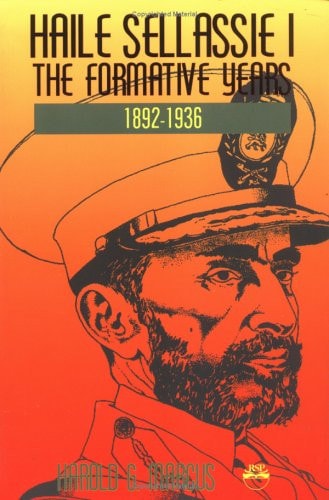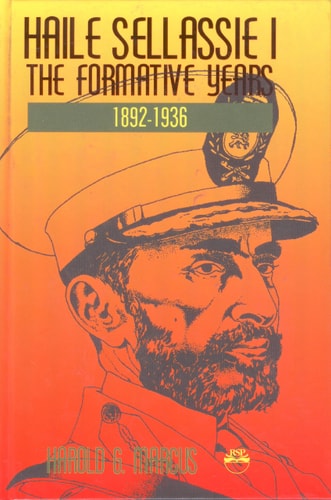
Haile Sellassie I: The Formative Years, 1892-1936
0
0
As an Amazon Associate and affiliate partner, Menrva Books earns from qualifying purchases. Learn more
Author Description
Always controversial during his lifetime (1892-1975), Haile Selassie became, after his dethronement in 1974, a political icon to some, a monster to others, and to all a legend. There is no understanding modern Ethiopia without a grasp of the Emperor's life. This first volume of a projected three-volume biography describes Haile Selassie's early training as a member of a cultural and political elite, a conditioning that led him to believe it was normal for an elite (later an oligarchy) to govern and exploit Ethiopia, even if many of its peoples did not benefit from the prevailing order. Once he became emperor, he viewed himself as the embodiment of Ethiopia's proud sovereignty and independence. Haile Selassie was the architect of the centralized Ethiopian state. He transformed Addis Abeba, his ramshackle capital, into a core city; educated a cadre of "Young Ethiopians"; and developed the central government. He managed his country's political and economic entry into the modern world and in the process made Ethiopia the central actor in Northeast Africa and himself a global figure. Between 1920 and 1935 Ethiopia made important and obvious progress toward modernization, which Italy regarded as potentially threatening to its African colonies. Haile Selassie, ever jealous of his country's sovereignty, redirected trade away from Europe toward Japan and the United States. By so doing he robbed France of a good economic reason to protect Ethiopia from Italy, he alienated Great Britain, and he permitted Rome to contemplate his nation' s conquest. By 1934 Ethiopia was without allies and without the means to counter the Italian aggression. The Emperor suffered defeat, exile, and despair, but he would return in 1941, as a phoenix, to restore the status quo ante. - Back cover.
Menrva's Summary
THE THESIS
This biography examines the early life and rise to power of Haile Selassie I, exploring the formative influences that shaped his vision for modern Ethiopia. The book details his upbringing within Ethiopia's elite, his belief in the necessity of elite governance, and his transformation into the embodiment of Ethiopian sovereignty. It chronicles his efforts to centralize the state, modernize Addis Ababa, educate a new generation, and integrate Ethiopia into the global political and economic landscape, ultimately positioning Ethiopia as a key player in Northeast Africa and himself as an international figure.
THE SCOPE MAP
- Detailed account of Haile Selassie's early life and education (1892-1936).
- Analysis of the political and cultural elite conditioning that shaped his worldview.
- Exploration of his role in the creation of the centralized Ethiopian state.
- Examination of his modernization efforts, including urban development and education reform.
- Discussion of Ethiopia's international relations and economic redirection.
- Contextualization of Ethiopia's progress and its implications for Italian colonial ambitions.
- Analysis of Ethiopia's diplomatic isolation leading up to the Italian aggression.
THE AUTHORITY PERSPECTIVE
Harold G. Marcus's "Haile Sellassie I: The Formative Years, 1892-1936" is recognized as a foundational text for understanding the Ethiopian emperor's early life and ascent. The book is praised for its detailed exploration of the socio-political landscape that molded Selassie's leadership and his vision for a modern, sovereign Ethiopia. Marcus meticulously traces the emperor's transformation from a member of the elite to the architect of the centralized Ethiopian state, highlighting his significant contributions to modernization and international diplomacy. The work is considered essential for grasping the complexities of Ethiopia's history and Haile Selassie's pivotal role within it.
Page Count:
242
Publication Date:
1995-01-01
Publisher:
Red Sea Press
ISBN-10:
1569020078
ISBN-13:
9781569020074
Non-Fiction
History
Politics
Biography