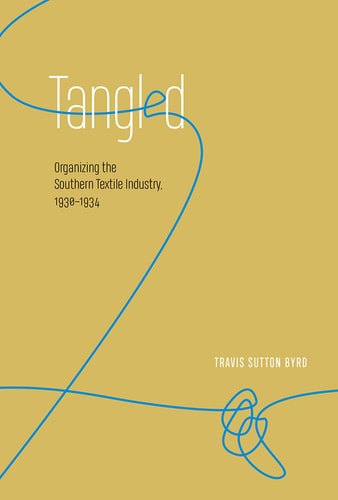
Tangled: Organizing the Southern Textile Industry, 1930-1934
0
0
As an Amazon Associate and affiliate partner, Menrva Books earns from qualifying purchases. Learn more
Author Description
Labor strife in piedmont mills had left eight dead in the summer of 1929, prompting the AFL-affiliated United Textile Workers of America (UTW) to strike an uneasy deal with the North Carolina governor. Their mutual goal was to root out and destroy the efforts of a rival communist organization, the National Textile Workers Union (NTWU), and thus erase Bolshevism in Dixie. The stage was set for a new round of conflict that would unfold over the next half-decade, not only in North Carolina but in several surrounding states. In this follow-up to Unraveled, his account of the 1929 events, Travis Sutton Byrd deftly explores a complex story of labor relations, political transitions, and emergent class consciousness in the industrial South. He seeks to answer why, with the coming of the Depression and New Deal initiatives to combat it, the region proved to be such a vexing battleground for labor organizers, whether mainstream or radical. This book examines the initiation and failure of the AFL/UTW's "Organize the South Campaign" and the attendant rise and demise of "Coalitionism"--a fusion between organized labor, progressive Republicans, and disaffected Democrats. It also documents the evolution of contradictory impulses--trade unionism and collective bargaining versus individualism and "right-to-work" doctrine--and pays special attention to the now-forgotten High Point, North Carolina, hosiery strike of 1932, which achieved its goals in remarkable fashion even though it never regularized under either the UTW or the NTWU. The story culminates in 1934, when a general strike swept the country in a desperate effort to force the reform promised by the National Recovery Act. Drawing especially on regional newspaper accounts to show how the key actors-- millhands, owners, organizers, and politicians--understood the events, Tangled is a thoroughly engrossing chronicle that carries vital lessons for today's labor leaders and policymakers.
Menrva's Summary
THE THESIS
Travis Sutton Byrd investigates the complex interplay of labor relations, political shifts, and burgeoning class consciousness within the industrial South during a tumultuous period from 1930 to 1934. Drawing on extensive regional newspaper accounts, Byrd examines why the South proved a difficult terrain for labor organizers, even amidst the Great Depression and New Deal initiatives. The book scrutinizes the failure of the AFL/UTW's
THE SCOPE MAP
- The initiation and failure of the AFL/UTW's "Organize the South Campaign"
- The rise and demise of "Coalitionism" (a fusion of organized labor, progressive Republicans, and disaffected Democrats)
- The evolution of contradictory impulses: trade unionism versus individualism and "right-to-work" doctrine
- A detailed account of the High Point, North Carolina, hosiery strike of 1932
- The national general strike of 1934 and its connection to the National Recovery Act
- Analysis of how millhands, owners, organizers, and politicians understood these events, particularly through regional newspaper accounts
THE AUTHORITY PERSPECTIVE
This book is a thoroughly engrossing chronicle that offers vital lessons for today's labor leaders and policymakers. Byrd's meticulous research, particularly his reliance on regional newspaper accounts, provides a granular view of the period. The work is positioned as a significant contribution to understanding the historical complexities of labor organizing in the American South. It delves into the specific challenges and contradictions faced by workers and organizers during a critical era of economic and political transition.
Page Count:
356
Publication Date:
2018-01-01
Publisher:
University of Tennessee Press
ISBN-10:
1621904075
ISBN-13:
9781621904076
Non-Fiction
History
American South
Political History
Industrial Relations
Economic History
Labor history
Community Tags
Similar Books