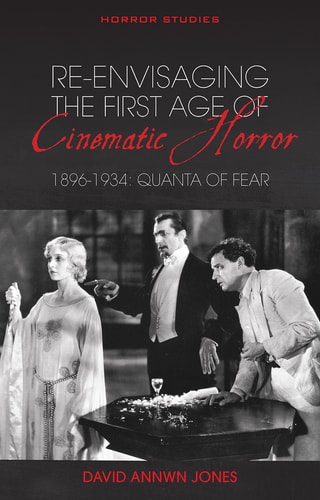
Re-envisaging the First Age of Cinematic Horror, 1896-1934
0
0
As an Amazon Associate and affiliate partner, Menrva Books earns from qualifying purchases. Learn more
Author Description
This is a ground-breaking exploration that runs generally against the critical grain in identifying a burgeoning production of films of fear and horror before the admission of the horror film genre per se. It is a study that reveals and emphasises the formative and innovative power of film, from Georges Méliès's Le Manoir du Diable (1896) to Edgar G. Ulmer's superbly reflexive The Black Cat (1934). With its focus on twenty-one key films, and referencing other relevant productions, the present study involves an inclusive and sensitive approach. It reveals an awareness of the heterogeneity of horror production with the discussion spanning the period of the invention of movies, the expansion from single-reelers to longer and continuous productions, and the advent of talkies. Stepping beyond the bounds of Anglo-American studios, in its seven chapters the book involves the work of directors from France, Spain, England, Moravia, Germany, Italy, Denmark, Mexico and the USA, to consider and compare films that have not previously received serious attention.
Menrva's Summary
THE THESIS
This study challenges conventional timelines by identifying a significant body of horror films produced prior to the formal establishment of the genre. The book argues for the formative and innovative power of early cinema, tracing the evolution of fear-inducing films from Georges Méliès's 1896 work to Edgar G. Ulmer's 1934 film, The Black Cat. It examines twenty-one key films and references others, adopting an inclusive approach that acknowledges the diverse nature of horror production across different eras and regions. The discussion spans the invention of movies, the transition from short films to longer features, and the advent of sound, offering a comprehensive view of early cinematic horror.
THE SCOPE MAP
- Exploration of early cinematic horror from 1896 to 1934.
- Focus on twenty-one key films, including Georges Méliès's Le Manoir du Diable and Edgar G. Ulmer's The Black Cat.
- Analysis of the development of horror films before the genre's official recognition.
- Discussion of the transition from early single-reelers to longer productions.
- Inclusion of the impact of 'talkies' on horror cinema.
- Examination of films from diverse international studios, including France, Spain, England, Moravia, Germany, Italy, Denmark, Mexico, and the USA.
- Consideration of films that have previously received limited critical attention.
- An inclusive and sensitive approach to understanding the heterogeneity of horror production.
THE AUTHORITY PERSPECTIVE
This book offers a revisionist perspective on the history of cinematic horror, challenging the established critical narrative by highlighting the significant output of fear-based films predating the genre's formal definition. The study's broad geographical and chronological scope, encompassing early silent films through to the advent of sound and drawing from a wide array of international productions, suggests a comprehensive and detailed examination. Its focus on lesser-known films and directors indicates a commitment to uncovering overlooked aspects of film history. The detailed analysis of specific works, combined with a broad contextualization of early cinema's evolution, positions the book as a valuable contribution to film studies.
Page Count:
272
Publication Date:
2018-11-14
Publisher:
University of Wales Press
ISBN-10:
1786833379
ISBN-13:
9781786833372
Non-Fiction
History
Art
Horror
Film Studies
Cinema History
Community Tags
Similar Books