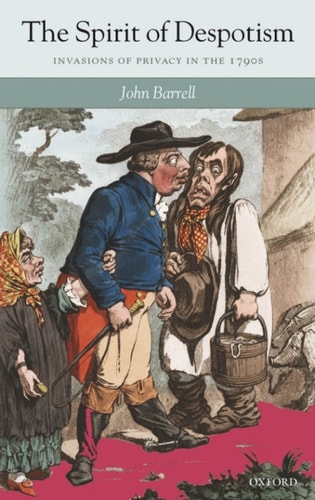
The Spirit of Despotism: Invasions of Privacy in the 1790s
0
0
As an Amazon Associate and affiliate partner, Menrva Books earns from qualifying purchases. Learn more
Author Description
How was the social and cultural life of Britain affected by the fear that the French Revolution would spread across the channel? In this brilliant, engagingly written, and profusely illustrated book, John Barrell, well-known for his studies of the history, literature, and art of the period, argues that the conflict between the ancien regime in Britain and the emerging democratic movement was so fundamental that it could not be contained within what had previously been thought of as the 'normal' arena of politics. Activities and spaces which had previously been regarded as 'outside' politics suddenly no longer seemed to be so, and the fear of revolution produced a culture of surveillance and suspicion which penetrated every aspect of private life. Drawing on an unusually wide range of sources, including novels, poems, plays, newspapers, debates in parliament, trials, political pamphlets, and caricatures, The Spirit of Despotism focuses on a number of examples of such invasions of privacy. It shows how the culture of suspicion affected how people spoke and behaved in London coffee-houses; how it influenced attitudes to the king's behaviour in private, especially during his summer holidays in Weymouth; how it infiltrated the country cottage, previously idealized as a protected haven of peace and retirement from political life; and how it influenced the fashion of the period, so that even the way people chose to style their hair came to be seen as a political issue.
Menrva's Summary
THE THESIS
This book investigates how the fear of the French Revolution infiltrating Britain during the 1790s fundamentally altered the boundaries between public political life and private personal existence. John Barrell, a scholar noted for his interdisciplinary work on British history, literature, and art, utilizes a diverse array of primary sources to argue that the perceived threat of radicalism forced the state and society to monitor previously private spaces. He posits that this pervasive culture of surveillance transformed mundane activities, such as social gatherings and personal fashion, into sites of political scrutiny and ideological conflict.
THE SCOPE MAP
What You Will Find
- Analysis of political surveillance in 1790s Britain
- Examination of private spaces including coffee-houses and country cottages
- Study of cultural artifacts such as caricatures, pamphlets, and contemporary literature
- Investigation into the politicization of personal behavior and fashion
Scope Limits
- The analysis is strictly confined to the British experience during the 1790s
- The text does not provide a comprehensive military history of the era
THE AUTHORITY PERSPECTIVE
Scholars and historians recognize this work as a significant contribution to the study of British political culture during the late eighteenth century. Readers frequently note the academic density of the prose and the author's meticulous use of varied primary source materials to support his arguments.
Page Count:
304
Publication Date:
2006-01-01
Publisher:
Oxford University Press
ISBN-10:
019151568X
ISBN-13:
9780191515682
History
English & College Success
Despotism
Political History
Social History
18th century
Cultural History
English
British History
Community Tags
Similar Books