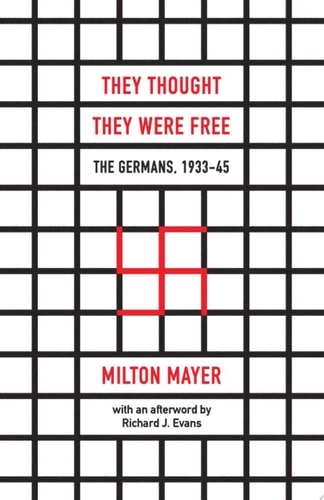
They Thought They Were Free: The Germans, 1933–45
0
0
As an Amazon Associate and affiliate partner, Menrva Books earns from qualifying purchases. Learn more
Author Description
The classic, chilling account of how fascism took over Germany—and of the constant danger of complacency “When this book was first published it received some attention from the critics but none at all from the public. Nazism was finished in the bunker in Berlin and its death warrant signed on the bench at Nuremberg.” That’s Milton Mayer, writing in a foreword to the 1966 edition of They Thought They Were Free. He’s right about the critics: the book was a finalist for the National Book Award in 1956. General readers may have been slower to take notice, but over time they did—what we’ve seen over decades is that any time people, across the political spectrum, start to feel that freedom is threatened, the book experiences a ripple of word-of-mouth interest. They Thought They Were Free is an eloquent and provocative examination of the development of fascism in Germany. Mayer’s book is a study of ten Germans and their lives from 1933-45, based on interviews he conducted after the war when he lived in Germany. Mayer had a position as a research professor at the University of Frankfurt and lived in a nearby small Hessian town which he disguised with the name “Kronenberg.” “These ten men were not men of distinction,” Mayer noted, but they had been members of the Nazi Party; Mayer wanted to discover what had made them Nazis. His discussions with them of Nazism, the rise of the Reich, and mass complicity with evil became the backbone of this book, an indictment of the ordinary German that is all the more powerful for its refusal to let the rest of us pretend that our moment, our society, our country are fundamentally immune. A new foreword to this edition by eminent historian of the Reich Richard J. Evans puts the book in historical and contemporary context. We live in an age of fervid politics and hyperbolic rhetoric. They Thought They Were Free cuts through that, revealing instead the slow, quiet accreti
Menrva's Summary
THE THESIS
This book investigates the insidious nature of fascism and the psychological mechanisms that enabled ordinary Germans to become complicit in the Nazi regime. Milton Sanford Mayer, a research professor at the University of Frankfurt, conducted interviews with ten ordinary Germans who had been members of the Nazi Party after World War II. Living in a disguised small town he called "Kronenberg," Mayer sought to understand what motivated these individuals to join the party and participate in its atrocities. The book examines their lives from 1933 to 1945, presenting a powerful indictment of mass complicity with evil by focusing on the seemingly unremarkable.
THE SCOPE MAP
- A detailed examination of the lives of ten ordinary Germans who were members of the Nazi Party.
- Analysis of the psychological and social factors contributing to the rise of fascism in Germany.
- Interviews conducted by the author after World War II, providing firsthand accounts.
- A study of the period from 1933 to 1945, focusing on the development of Nazism and complicity.
THE AUTHORITY PERSPECTIVE
Milton Mayer's "They Thought They Were Free: The Germans, 1933-45" is a seminal work that has garnered significant critical attention over the decades, notably being a finalist for the National Book Award in 1956. Its enduring relevance is marked by recurring waves of interest whenever discussions of threatened freedoms arise. The book is recognized for its provocative examination of fascism's development through the lens of ordinary individuals, offering a chilling account of complacency and complicity. Richard J. Evans' foreword to the 2017 edition places Mayer's work within contemporary political discourse, highlighting its continued importance in understanding societal susceptibility to authoritarianism.
Page Count:
378
Publication Date:
2017-11-28
Publisher:
University of Chicago Press
ISBN-10:
022652583X
ISBN-13:
9780226525839
Politics
History
Non-Fiction
Sociology
Community Tags
Similar Books