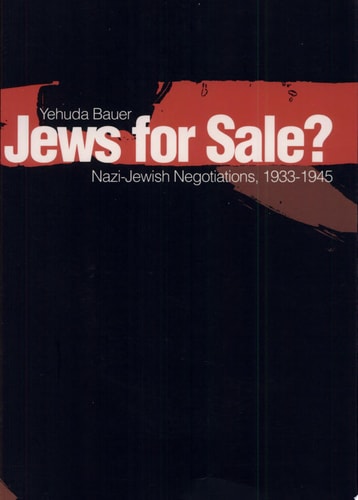
Jews for Sale? Nazi-Jewish Negotiations, 1933-1945
0
0
As an Amazon Associate and affiliate partner, Menrva Books earns from qualifying purchases. Learn more
Author Description
The world has recently learned of Oskar Schindler's efforts to save the lives of Jewish workers in his factory in Poland by bribing Nazi officials. Not as well known, however, are many other equally dramatic attempts to negotiate with the Nazis for the release of Jews in exchange for money, goods, or political benefits. In this riveting book, a leading Holocaust scholar examines these attempts, describing the cast of characters, the motives of the participants, the frustrations and few successes, and the moral issues raised by the negotiations. Drawing on a wealth of previously unexamined sources, Yehuda Bauer deals with the fact that before the war Hitler himself was willing to permit the total emigration of Jews from Germany in order to be rid of them. In the end, however, there were not enough funds for the Jews to buy their way out, there was no welcome for them abroad, and there was too little time before war began. Bauer then concentrates on the negotiations that took place between 1942 and 1945 as Himmler tried to keep open options for a separate peace with the Western powers. In fascinating detail Bauer portrays the dramatic intrigues that took place: a group of Jewish leaders bribed a Nazi official to stop the deportation of Slovakian Jews; a Czech Jew known as Dogwood tried to create an alliance between American leaders and conservative German anti-Nazis; Adolf Eichmann's famous "trucks for blood" proposal to exchange one million Jews for trucks to use against the Soviets failed because of Western reluctance; and much more. Tormenting questions arise throughout Bauer's discussion. If the Nazis were actually willing to surrender more Jews, should the Allies have acted on the offer? Did the efforts to exchange lives for money constitute collaboration with the enemy or heroism? In answering these questions, Bauer's book—engrossing, profound, and deeply moving—adds a new dimension to Holocaust studies.
Menrva's Summary
THE THESIS
The central question of this book is whether and how Jews attempted to negotiate with the Nazi regime for their own survival during the Holocaust. The book examines various attempts, from pre-war emigration schemes to wartime proposals, detailing the complex motivations of both Nazi officials and Jewish individuals or groups. It explores the constraints imposed by the Nazis' genocidal policies, the lack of international support, and the moral quandaries inherent in negotiating with perpetrators.
THE SCOPE MAP
- Analysis of pre-war German-Jewish emigration negotiations and Hitler's willingness to permit total emigration.
- Examination of Himmler's attempts to negotiate separate peace options with Western powers between 1942 and 1945.
- Detailed accounts of specific negotiation attempts, such as bribing officials to stop deportations of Slovakian Jews.
- Exploration of the 'trucks for blood' proposal by Adolf Eichmann to exchange one million Jews for trucks.
- Discussion of the moral and ethical dilemmas faced by those involved in such negotiations.
- Inclusion of previously unexamined sources to provide a comprehensive historical account.
- Analysis of the limited success and profound frustrations encountered in these efforts.
THE AUTHORITY PERSPECTIVE
Yehuda Bauer's work is recognized as a significant contribution to Holocaust studies, offering a new dimension by focusing on the complex and often agonizing negotiations between Nazi officials and Jewish individuals or groups. The book is noted for its engrossing narrative, profound analysis, and deeply moving exploration of the moral issues raised by these attempts to bargain for lives. It draws on extensive, previously unexamined sources to present a detailed account of both the frustrations and the rare successes encountered.
Page Count:
306
Publication Date:
1994-01-01
Publisher:
Yale University Press
ISBN-10:
0300068522
ISBN-13:
9780300068528
Non-Fiction
History
Ethics
Jewish History
Community Tags
Similar Books