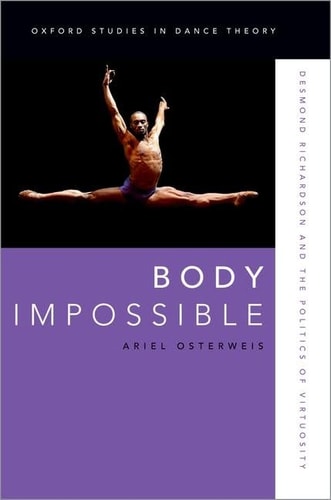
Body Impossible: Desmond Richardson and the Politics of Virtuosity
0
0
As an Amazon Associate and affiliate partner, Menrva Books earns from qualifying purchases. Learn more
Author Description
Body Impossible theorizes the concept of virtuosity in contemporary dance and performance through a study of the career of dancer Desmond Richardson. A virtuoso for the ages, Richardson is renowned for delivering commanding performances over decades in contexts ranging from the stages of the Alvin Ailey American Dance Theater and Ballett Frankfurt to featured appearances with Michael Jackson and Prince, along with his work as co-founder of Complexions Contemporary Ballet, inaugurating a virtuosic queer black aesthetic with choreographer Dwight Rhoden.Focusing on Richardson's creative insistence on improvisatory fun and excellence throughout the decades approaching the millennium (shaped by Reaganism, the Culture Wars, the AIDS epidemic, the New Jim Crow, and MTV), this book brings dance into conversation with paradigms of blackness, queerness, masculinity, and class in order to generate a socioculturally attentive understanding of virtuosity.Virtuosity obscures the border between popular and concert performance, and Richardson's versatility epitomizes the demands on the contemporary virtuosic dance artist. Author Ariel Osterweis suggests that discourses of virtuosity are linked to connotations of excess, and that an examination of the formal and socio-cultural aspects of virtuosic performance reveals under-recognized heterogeneity in which we detect “vernacular” influences on “high art.” In doing so, Body Impossible accounts for the constitutive relationship between disciplined perceptions of virtuosity's excess and the disciplining of the racialized body in national and transnational contexts.
Menrva's Summary
THE THESIS
This book investigates how the concept of virtuosity in contemporary dance functions as a site for negotiating racial, queer, and class-based identities. Author Ariel Osterweis, a scholar in dance theory, utilizes the career of dancer Desmond Richardson as a primary case study to analyze how virtuosic performance intersects with broader sociopolitical forces. By examining Richardson's work across diverse venues—from the Alvin Ailey American Dance Theater to pop music stages—Osterweis argues that virtuosity is not merely a display of technical skill but a disciplined, often racialized, performance that reflects the tensions of the late 20th century.
THE SCOPE MAP
What You Will Find
- Analysis of Desmond Richardson's career trajectory across concert dance and popular media.
- Theoretical framework linking virtuosity to excess, blackness, and queer masculinity.
- Examination of the intersection between 'high art' and 'vernacular' performance styles.
- Contextualization of dance within the Culture Wars, the AIDS epidemic, and the Reagan era.
Scope Limits
- The study does not provide a comprehensive biography of Richardson's personal life outside of his professional performance career.
- The analysis focuses primarily on the American context, with limited exploration of non-Western dance traditions.
THE AUTHORITY PERSPECTIVE
Scholars in dance studies and performance theory recognize this work as a significant contribution to the intersection of somatic practice and cultural politics. Readers frequently note the academic density of the prose, which is intended for those familiar with critical theory and dance historiography.
Page Count:
240
Publication Date:
2024-01-01
Publisher:
Oxford University Press
ISBN-10:
0190645814
ISBN-13:
9780190645816
Politics
Biography
Mid Atlantic
Dancers
Community & Culture
Queer Theory
Leaders & Notable People
South
Black studies
Regional US
LGBTQ Studies
Dance
Ethnic Studies
African American
Community Tags
Other Editions(2)
Similar Books