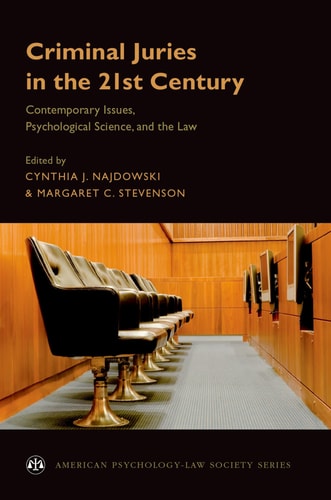
Criminal Juries in the 21st Century: Psychological Science and the Law
0
0
As an Amazon Associate and affiliate partner, Menrva Books earns from qualifying purchases. Learn more
Author Description
The jury is often hailed as one of the most important symbols of American democracy. Yet much has changed since the Sixth Amendment in 1791 first guaranteed all citizens the right to a jury trial in criminal prosecutions. Experts now have a much more nuanced understanding of the psychological implications of being a juror, and advances in technology and neuroscience make the work of rendering a decision in a criminal trial more complicated than ever before.Criminal Juries in the 21st Century explores the increasingly wide gulf between criminal trial law, procedures, and policy, and what scientific findings have revealed about the human experience of serving as a juror. Readers will contemplate myriad legal issues that arise when jurors decide criminal cases as well as cutting-edge psychological research that can be used to not only understand the performance and experience of the contemporary criminal jury, but also to improve it. Chapter authors grapple with a number of key issues at the intersection of psychology and law, guiding readers to consider everything from the factors that influence the initial selection of the jury to how jurors cope with and reflect on their service after the trial ends. Together the chapters provide a unique view of criminal juries with the goal of increasing awareness of a broad range of current issues in great need of theoretical, empirical, and legal attention. Criminal Juries in the 21st Century will identify how social science research can inform law and policy relevant to improving justice within the jury system, and is an essential resource for those who directly study jury decision making as well as social scientists generally, attorneys, judges, students, and even future jurors.
Menrva's Summary
THE THESIS
This volume investigates the widening disparity between contemporary criminal trial procedures and empirical psychological findings regarding juror decision-making. Edited by Cynthia J. Najdowski and Margaret C. Stevenson, the text compiles contributions from experts in psychology and law to evaluate how modern scientific research can inform and improve the American jury system. The authors utilize a multidisciplinary framework to bridge the gap between historical legal mandates and current cognitive and social science data.
THE SCOPE MAP
What You Will Find
- Analysis of jury selection processes and juror cognitive biases
- Examination of the impact of modern technology and neuroscience on trial outcomes
- Discussion of post-trial juror experiences and psychological coping mechanisms
- Integration of social science research into legal policy and practice
Scope Limits
- The text focuses primarily on the American legal system and may not reflect international jury practices
- It does not provide a comprehensive legal manual for trial attorneys but rather a scholarly overview of psychological intersections
THE AUTHORITY PERSPECTIVE
Experts identify this collection as a significant resource for understanding the intersection of behavioral science and the courtroom. Readers frequently note the academic density of the prose, making it a suitable text for students, legal professionals, and researchers in the field of psychology and law.
Page Count:
352
Publication Date:
2018-09-17
Publisher:
Oxford University Press
ISBN-10:
0190658118
ISBN-13:
9780190658113
Psychology
Legal Studies
Jury
Jury Selection
Social Science
Professional Career & Trade
Law
Community Tags
Similar Books