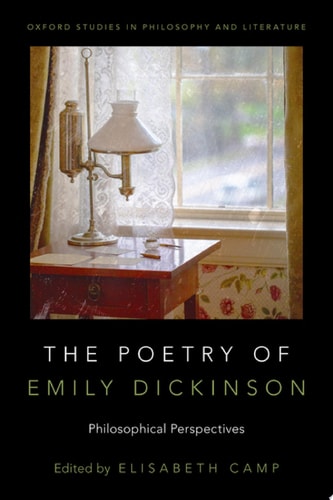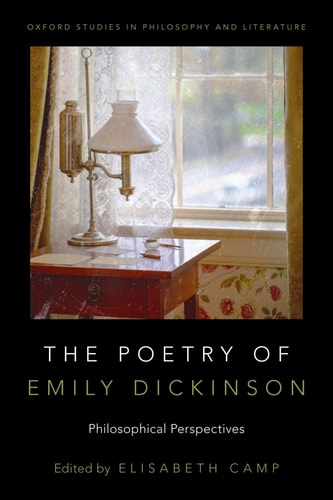
The Poetry of Emily Dickinson: Philosophical Perspectives
0
0
As an Amazon Associate and affiliate partner, Menrva Books earns from qualifying purchases. Learn more
Author Description
One of America's most celebrated poets, Emily Dickinson was virtually unpublished in her lifetime. When a slim volume of her poems emerged on the American scene in 1890, her work created shockwaves that have not subsided yet. Famously precise and sparse, Emily Dickinson's poetry is often described as philosophical, both because her poetry grapples with philosophical topics like death, spirituality, and the darkening operations of the mind, and because she approaches those topics in a characteristically philosophical manner: analyzing and extrapolating from close observation, exploring alternatives, and connecting thoughts into cumulative demonstrations. But unlike Lucretius or Pope, she cannot be accused of producing versified treatises. Many of her poems are unsettling in their lack of conclusion; their disparate insights often stand in conflict; and her logic turns crucially on imagery, juxtaposition, assonance, slant rhyme, and punctuation.The six chapters of this volume collectively argue that Dickinson is an epistemically ambitious poet, who explores fundamental questions by advancing arguments that are designed to convince. Dickinson exemplifies abstract ideas in tangible form and habituates readers into productive trains of thought--she doesn't just make philosophical claims, but demonstrates how poetry can make a distinct contribution to philosophy.All essays in this volume, drawn from both philosophers and literary theorists, serve as a counterpoint to recent critical work, which has emphasized Dickinson's anguished uncertainty, her nonconventional style, and the unsettled status of her manuscripts. On the view that emerges here, knowing is like cleaning, mending, and lacemakingL a form of hard, ongoing work, but one for which poetry is a powerful, perhaps indispensable, tool.
Menrva's Summary
THE THESIS
This volume investigates the extent to which Emily Dickinson’s poetry functions as a rigorous philosophical inquiry rather than merely an aesthetic or emotional expression. Elisabeth Camp, an expert in philosophy and literature, curates a collection of essays that challenge the prevailing critical focus on Dickinson’s biographical instability and stylistic fragmentation. The contributors argue that Dickinson employs a deliberate, analytical methodology to explore epistemological questions, positioning her work as a distinct contribution to philosophical discourse.
THE SCOPE MAP
What You Will Find
- Six chapters analyzing the intersection of poetic form and philosophical argumentation
- Examinations of Dickinson’s treatment of death, spirituality, and cognitive processes
- Comparative analysis of Dickinson’s methods against traditional philosophical treatises
Scope Limits
- The text does not provide a comprehensive biography of the poet’s life
- It avoids focusing on the textual history or manuscript variations of the poems
THE AUTHORITY PERSPECTIVE
Experts recognize this volume as a significant intervention in Dickinson studies, shifting the focus toward the intellectual rigor of her work. Readers frequently note the academic density of the prose, which is intended for scholars and advanced students of literature and philosophy.
Page Count:
224
Publication Date:
2021-02-01
Publisher:
Oxford University Press
ISBN-10:
0190651202
ISBN-13:
9780190651206
Philosophy
Poetry
American
Literary Criticism
Academic
Community Tags
Other Editions(2)
Similar Books