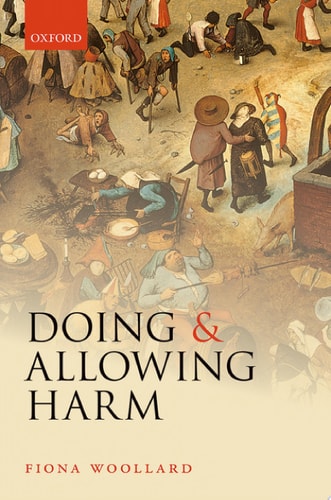
Doing and Allowing Harm
0
0
As an Amazon Associate and affiliate partner, Menrva Books earns from qualifying purchases. Learn more
Author Description
Doing harm seems much harder to justify than merely allowing harm. If a boulder is rushing towards Bob, you may refuse to save Bob's life by driving your car into the path of the boulder if doing so would cost you your own life. You may not push the boulder towards Bob to save your own life. This principle--the Doctrine of Doing and Allowing--requires defence. Does the distinction between doing and allowing fall apart under scrutiny? When lives are at stake, how can it matter whether harm is done or allowed? Drawing on detailed analysis of the distinction between doing and allowing, Fiona Woollard argues that the Doctrine of Doing and Allowing is best understood as a principle that protects us from harmful imposition. Such protection against imposition is necessary for morality to recognize anything as genuinely belonging to a person, even that person's own body. As morality must recognize each person's body as belonging to her, the Doctrine of Doing and Allowing should be accepted. Woollard defends a moderate account of our obligations to aid, tackling arguments by Peter Singer and Peter Unger that we must give most of our money away and arguments from Robert Nozick that obligations to aid are incompatible with self-ownership.
Menrva's Summary
THE THESIS
This work investigates whether the moral distinction between doing harm and allowing harm is defensible or if it collapses under rigorous philosophical scrutiny. Fiona Woollard, a philosopher specializing in ethics, examines the Doctrine of Doing and Allowing (DDA) to determine its role in moral theory. She argues that the DDA is essential for protecting individuals from harmful impositions, asserting that this protection is a prerequisite for the concept of self-ownership and bodily autonomy. By addressing the tension between obligations to aid others and the rights of the individual, Woollard provides a framework that reconciles these competing moral demands.
THE SCOPE MAP
What You Will Find
- A detailed analysis of the Doctrine of Doing and Allowing (DDA)
- A defense of moderate obligations to aid others
- Philosophical counter-arguments to the positions of Peter Singer, Peter Unger, and Robert Nozick
- An exploration of the relationship between bodily autonomy and moral impositions
Scope Limits
- The text does not provide a comprehensive guide to all areas of normative ethics
- It focuses primarily on the DDA rather than broader political or social policy applications
THE AUTHORITY PERSPECTIVE
Experts in moral philosophy recognize this text as a significant contribution to the ongoing debate regarding the moral status of doing versus allowing harm. Readers frequently note the academic density of the prose, which is intended for those with a background in analytic philosophy.
Page Count:
256
Publication Date:
2015-01-01
Publisher:
OUP Oxford
ISBN-10:
0191506559
ISBN-13:
9780191506550
Philosophy
Political Philosophy
Ethics
Applied ethics
Moral Philosophy
Responsibility
Community Tags
Similar Books