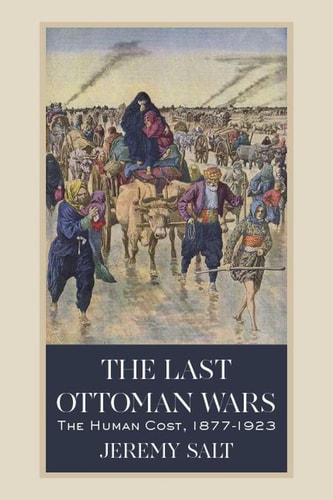
The Last Ottoman Wars: The Human Cost, 1877-1923
0
0
As an Amazon Associate and affiliate partner, Menrva Books earns from qualifying purchases. Learn more
Author Description
Jeremy Salt's manuscript "The last Ottoman wars" is a unique, timely, and humane study of warfare and its many costs in a region that has been fought over and upon for centuries. The Ottoman Empire and its surrounding territories, which in this work covers the Balkans to eastern Anatolia and the Caucasus, was during the last decades of the nineteenth century and the first decades of the twentieth a place of political unrest and constant military action. Historians have since chronicled and contested questions of how, what, where, when, and why battlefield or diplomatic strategies failed or succeeded as they did in Ottoman-European conflicts. So too have historians questioned how and to what degree the actions of generals and statesmen, as well as financiers, resulted in ruin for millions of Ottoman peoples, specifically Armenians and other Ottoman Christians. Overlooked, according to Salt, have been millions of Ottoman Muslims, who during the time period in question were massacred and displaced before the advance and against the retreat of invading armies. This manuscript is, as Salt writes, an attempt "to bring these invisible victims of war back into the picture." "The Last Ottoman Wars" offers readers a glimpse into the daily lives of Ottoman Muslims, and indeed all ordinary Ottoman citizens. Instead of following the nations and individuals desperate to get what spoils they could from an empire in decline, Salt centers his focus on those left to live with what remained after nearly all had been taken. These people, at the edge of modernity, lived with malnutrition, disease, internecine violence, and crumbling infrastructures a generation before World War I and immediately after its devastation
Menrva's Summary
THE THESIS
This book investigates the often-overlooked human cost of the final conflicts of the Ottoman Empire, focusing on the suffering of ordinary citizens, particularly Muslims, caught in the crossfire. Jeremy Salt's work examines the period from 1877 to 1923, a time of intense political unrest and military action across the Balkans, eastern Anatolia, and the Caucasus. While historical accounts often focus on the strategies of generals and statesmen or the plight of Christian minorities like Armenians, Salt brings to light the experiences of millions of Ottoman Muslims who faced massacre and displacement. The study centers on those left to rebuild their lives amidst malnutrition, disease, and violence in the wake of devastating wars.
THE SCOPE MAP
- An examination of the human cost of warfare in the Ottoman Empire from 1877 to 1923.
- Focus on the experiences of ordinary Ottoman citizens, with a particular emphasis on Muslims.
- Coverage of the Balkans, eastern Anatolia, and the Caucasus as key conflict zones.
- Analysis of the impact of malnutrition, disease, and internecine violence on civilian populations.
- A counter-narrative to historical accounts that prioritize military strategy or the suffering of specific ethnic/religious groups.
- Exploration of the aftermath of war and its lasting effects on individuals and communities.
THE AUTHORITY PERSPECTIVE
The book is presented as a unique and humane study that addresses a neglected aspect of Ottoman history. By focusing on the 'invisible victims of war,' particularly Ottoman Muslims, it aims to rebalance historical narratives that have often overlooked their suffering. The work is positioned to offer readers a deeper understanding of the daily lives and struggles of ordinary citizens during a period of immense upheaval and conflict.
Page Count:
424
Publication Date:
2019-01-01
Publisher:
University of Utah Press
ISBN-10:
1607817047
ISBN-13:
9781607817048
History
Non-Fiction
Balkans
Caucasus
Armenians
Ottoman Empire
Military History
Community Tags
Similar Books