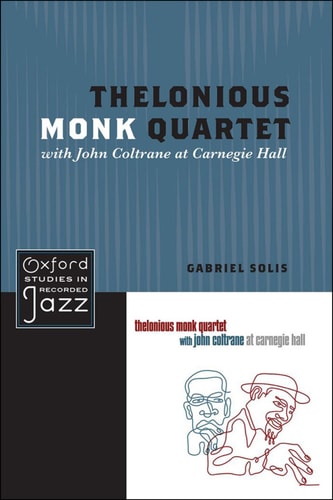
Thelonious Monk Quartet with John Coltrane at Carnegie Hall
0
0
As an Amazon Associate and affiliate partner, Menrva Books earns from qualifying purchases. Learn more
Author Description
In early 2005, an engineer at the Library of Congress accidentally discovered, in an unmarked box, the recording of Thelonious Monk's and John Coltrane's performance at a 1957 benefit concert at Carnegie Hall. Long considered one of the most important musical meetings in modern jazz, Monk's and Coltrane's work together during a scant few months in 1957 had, until this discovery, been thought to be almost entirely undocumented.In this book, Gabriel Solis provides an historical, cultural, and analytical study of this landmark recording, which was released by Blue Note records later in 2005. Taking a wide-ranging approach to the recording, Solis addresses issues of "liveness," jazz teaching and learning, enculturation, and historiography. Because nearly a half century passed between when the recording was made and its public release, it is a particularly interesting lens through which to view jazz both as a historical tradition and as a contemporary cultural form. Most importantly Solis accounts for the music itself. Offering in depth analytical discussions of each composition, as well as Monk's and Coltrane's improvisational performances he provides insight into Monk's impact on Coltrane as he developed his signature "sheets of sound" style, as well as into the influence of a strong side-man, like Coltrane, on Monk at his creative and professional peak. The first study of one of the most significant jazz releases of the twenty-first century, Thelonious Monk Quartet with John Coltrane at Carnegie Hall is essential reading for all jazz scholars, students, musicians, and fans.
Menrva's Summary
THE THESIS
How does the 1957 Carnegie Hall recording of Thelonious Monk and John Coltrane serve as a critical artifact for understanding the evolution of jazz as both a historical tradition and a living cultural practice? Gabriel Solis, a musicologist, utilizes the accidental 2005 discovery of this long-lost performance to examine the intersection of improvisation, pedagogy, and historiography. By analyzing the specific musical contributions of both artists during their brief collaboration, Solis constructs a framework that accounts for the technical development of Coltrane's improvisational style and the professional dynamics between the two jazz icons at their creative peak.
THE SCOPE MAP
What You Will Find
- Historical analysis of the 1957 Carnegie Hall benefit concert and the subsequent 2005 Blue Note release.
- Musicological breakdown of individual compositions and improvisational techniques.
- Examination of the influence of Monk's structural approach on Coltrane's emerging 'sheets of sound' aesthetic.
- Theoretical discussion regarding the concept of 'liveness' and the role of archival discovery in jazz historiography.
THE AUTHORITY PERSPECTIVE
Experts and jazz scholars recognize this work as a foundational text for understanding the specific collaborative period between Monk and Coltrane. Readers frequently note the academic density of the prose, which balances technical musical analysis with broader cultural and historical context.
Page Count:
208
Publication Date:
2013-01-01
Publisher:
Oxford University Press
ISBN-10:
0199913110
ISBN-13:
9780199913114
Music
History
Biography
Jazz
Humanities
Music History
Music theory
Community Tags
Other Editions(3)
Similar Books





Reader Comments
Share Your Thoughts
No comments yet. Be the first to share your thoughts!