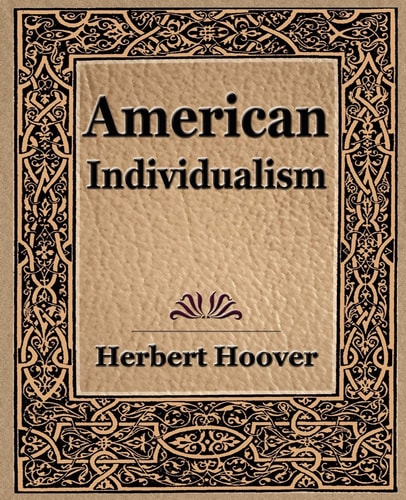
American Individualism
0
0
As an Amazon Associate and affiliate partner, Menrva Books earns from qualifying purchases. Learn more
Author Description
We Have witnessed in this last eight years the spread of revolution over one third of the world. The causes of these explosions lie at far greater depths than the failure of governments in war. The war itself in its last stages was a conflict of social philosophies but beyond this the causes of social explosion lay in the great inequalities and injustices of centuries flogged beyond endurance by the conflict and freed from restraint by the destruction of war. The urgent forces which drive human society have been plunged into a terrible furnace. Great theories spun by dreamers to remedy the pressing human ills have come to the front of men's minds.
Menrva's Summary
THE THESIS
Herbert Hoover's 1922 essay, "American Individualism," posits that the nation's unique strength and progress stem from its foundational commitment to individual liberty and self-reliance. Drawing on his experiences as an engineer and public servant, Hoover argues that the American system, which fosters individual initiative and opportunity, is the most effective model for societal advancement. He contrasts this with the collectivist ideologies emerging in the post-World War I era, asserting that they stifle innovation and lead to stagnation. The essay champions a philosophy where individual effort, coupled with a sense of social responsibility, forms the bedrock of a prosperous and free society.
THE SCOPE MAP
- An examination of the historical roots of American individualism.
- A critique of collectivist and socialist ideologies.
- An argument for the efficacy of individual initiative in driving economic and social progress.
- A discussion on the balance between individual rights and social obligations.
- Hoover's vision for the future of American society based on these principles.
THE AUTHORITY PERSPECTIVE
Herbert Hoover's "American Individualism" is often cited as a foundational text articulating a conservative, free-market perspective on societal organization. The essay is recognized for its clear defense of capitalist principles and individual responsibility as the engines of national prosperity. Its arguments continue to resonate in contemporary political and economic discourse, serving as a touchstone for debates on the role of government versus individual liberty. The work is generally viewed as a significant statement of American political philosophy from the early 20th century.
Page Count:
84
Publication Date:
2006-01-01
Publisher:
Standard Publications, Incorporated
ISBN-10:
1594622469
ISBN-13:
9781594622465
Non-Fiction
Economics
Politics
Philosophy
Community Tags
Similar Books