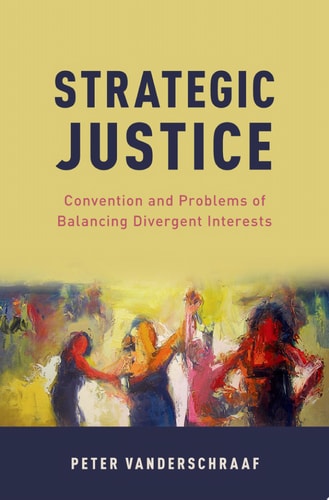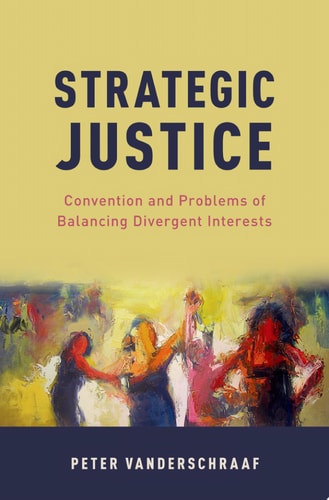
Strategic Justice: Convention and Problems of Balancing Divergent Interests
0
0
As an Amazon Associate and affiliate partner, Menrva Books earns from qualifying purchases. Learn more
Author Description
In Strategic Justice, Peter Vanderschraaf argues that justice can be properly understood as a body of special social conventions. The idea that justice is at bottom conventional has ancient roots, but has never been central in philosophy because convention itself has historically been so poorly understood. Vanderschraaf gives a new defense of this idea that integrates insights and arguments of past masters of moral and political philosophy together with recent analytical and empirical concepts and results from the social sciences. One of the substantial contributions of this work is a new account of convention that is sufficiently general for summarizing problems of justice, the social interactions where the interests of the agents involved diverge. Conventions are defined as equilibrium solutions to the games that summarize social interactions having a variety of possible stable resolutions and a corresponding plurality of equilibria. The basic idea that justice consists of a system of rules for mutual advantage is explored in depth using this game-theoretic analysis of convention. Justice is analyzed as a system of conventions that are stable with respect to renegotiation in the face of societal changes such as resource depletion, technological innovation and population decline or growth. This new account of justice-as-convention explains in a cogent and natural way what justice is and why individuals have good reason to obey its requirements. Contrary to what many have thought, this new account shows how the justice-as-convention view can give a good account of why justice requires that the most vulnerable members of society receive protections and benefits from the cooperative surplus created by general compliance with justice.
Menrva's Summary
THE THESIS
This work investigates whether justice can be rigorously defined as a system of social conventions derived from game-theoretic analysis. Peter Vanderschraaf, a scholar in moral and political philosophy, synthesizes historical philosophical traditions with contemporary analytical tools from the social sciences. He argues that justice functions as a set of stable equilibrium solutions to social interactions where individual interests diverge, providing a framework for why individuals are motivated to adhere to these rules.
THE SCOPE MAP
What You Will Find
- A formal game-theoretic definition of social conventions as equilibrium solutions.
- Analysis of justice as a system of rules for mutual advantage.
- Examination of how conventions maintain stability during societal shifts like resource depletion or technological change.
- Theoretical justification for protecting vulnerable populations within a cooperative surplus model.
Scope Limits
- The text focuses primarily on the analytical and game-theoretic dimensions of justice rather than theological or purely deontological moral frameworks.
- It does not provide a comprehensive history of all theories of justice, focusing instead on the conventionalist tradition.
THE AUTHORITY PERSPECTIVE
Scholars and students of political philosophy frequently note the high level of technical rigor and the dense, analytical nature of the prose. Experts highlight this work as a significant contribution to the revival of conventionalist theories of justice through the lens of modern social science.
Page Count:
413
Publication Date:
2018-01-01
Publisher:
Oxford University Press
ISBN-10:
0190660465
ISBN-13:
9780190660468
Philosophy
Political Philosophy
Social Science
Moral Theory
Game theory
Ethics