Empire of Ruin: Black Classicism and American Imperial Culture
0
0
As an Amazon Associate and affiliate partner, Menrva Books earns from qualifying purchases. Learn more
Author Description
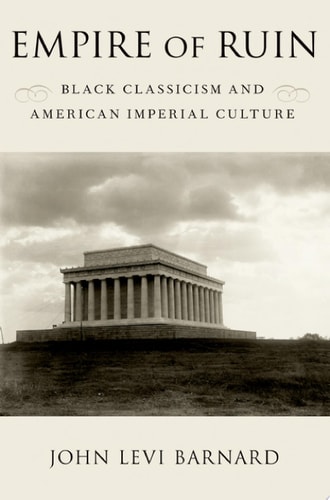
From the US Capitol to the Lincoln Memorial and the 9/11 Memorial Museum, classical forms and ideas have been central to an American nationalist aesthetic. Beginning with an understanding of this centrality of the classical tradition to the construction of American national identity and the projection of American power, Empire of Ruin describes a mode of black classicism that has been integral to the larger critique of American politics, aesthetics, and historiography that African American cultural production has more generally advanced. While the classical tradition has provided a repository of ideas and images that have allowed white American elites to conceive of the nation as an ideal Republic and the vanguard of the idea of civilization, African American writers, artists, and activists have characterized this dominant mode of classical appropriation as emblematic of a national commitment to an economy of enslavement and a geopolitical project of empire. If the dominant forms of American classicism and monumental culture have asserted the ascendancy of what Thomas Jefferson called an "empire for liberty," for African American writers and artists it has suggested that the nation is nothing exceptional, but rather another iteration of what the radical abolitionist Henry Highland Garnet identified as an "empire of slavery," inexorably devolving into an "empire of ruin."
Menrva's Summary
THE THESIS
This work investigates how African American cultural production utilizes and critiques the classical tradition to challenge the foundations of American imperial identity. John Levi Barnard, a scholar of American literature and culture, examines the tension between the white nationalist appropriation of classical forms and the counter-narratives developed by black writers, artists, and activists. He argues that while classicism was used to legitimize American power as an 'empire for liberty,' African American intellectuals reinterpreted these symbols to expose the nation's reliance on enslavement and its inevitable trajectory toward ruin.
THE SCOPE MAP
What You Will Find
- Analysis of classical architecture and iconography in American national monuments.
- Examination of literary and artistic responses to the 'empire for liberty' ideology.
- Historical critique of the 'empire of slavery' as identified by figures like Henry Highland Garnet.
- Theoretical framework connecting aesthetics, historiography, and political power.
Scope Limits
- The text focuses primarily on the intersection of black cultural production and classical tradition rather than a comprehensive history of American classicism itself.
- It does not provide an exhaustive survey of all classical references in American art, focusing instead on those relevant to the critique of imperialism.
THE AUTHORITY PERSPECTIVE
Scholars in the fields of American studies and critical race theory identify this text as a significant contribution to understanding the role of aesthetics in national identity formation. Readers frequently note the academic density of the prose and the rigorous interdisciplinary approach used to connect classical antiquity with modern American political critique.
Page Count:
245
Publication Date:
2017-01-01
Publisher:
Oxford University Press
ISBN-10:
0190663618
ISBN-13:
9780190663612
History
Classics
Literary Criticism
In literature
English
Authors American
African Americans
African American
English & College Success
Community Tags
Similar Books