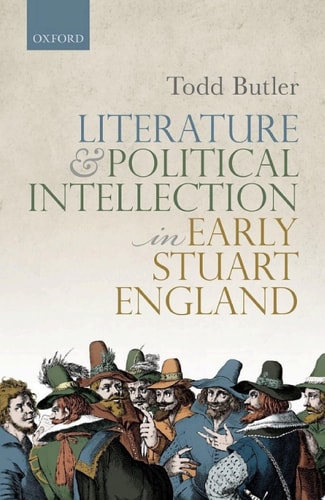
Literature and Political Intellection in Early Stuart England
0
0
As an Amazon Associate and affiliate partner, Menrva Books earns from qualifying purchases. Learn more
Author Description
Drawing upon a myriad of literary and political texts, Literature and Political Intellection in Early Stuart England charts how some of the Stuart period's major challenges to governance--the equivocation of recusant Catholics, the parsing of one's civil and religious obligations, the composition and distribution of subversive texts, and the increasing assertiveness of Parliament--evoked much greater disputes about the mental processes by which monarchs and subjects alike imagined, understood, and effected political action. Rather than emphasizing particular forms of political thought such as republicanism or absolutism, Todd Butler here investigates the more foundational question of political intellection, or the various ways that early modern individuals thought through the often uncertain political and religious environment they occupied, and how attention to such thinking in oneself or others could itself constitute a political position. Focusing on this continuing immanence of cognitive processes in the literature of the Stuart era, Butler examines how writers such as Francis Bacon, John Donne, Philip Massinger, John Milton, and other less familiar figures of the seventeenth-century evidence a shared concern with the interrelationship between mental and political behavior. These analyses are combined with similarly close readings of religious and political affairs that similarly return our attention to how early Stuart writers of all sorts understood the relationship between mental states and the forms of political engagement such as speech, oaths, debate, and letter-writing that expressed them. What results is a revised framework for early modern political subjectivity, one in which claims to liberty and sovereignty are tied not simply to what one can do but how--or even if--one can freely think.
Menrva's Summary
THE THESIS
This book investigates how early Stuart writers and political actors conceptualized the relationship between cognitive processes and political engagement. Todd Butler, a scholar of early modern literature, utilizes a wide array of political and literary texts to argue that political subjectivity in the seventeenth century was fundamentally rooted in the mechanics of thought. By examining how individuals navigated religious and civil uncertainty, Butler posits that the act of thinking itself served as a primary site of political positioning and agency.
THE SCOPE MAP
What You Will Find
- Analysis of political challenges including recusant Catholic equivocation and parliamentary assertiveness.
- Examination of literary works by Francis Bacon, John Donne, Philip Massinger, and John Milton.
- A framework for understanding political subjectivity through cognitive processes rather than static ideologies.
- Close readings of seventeenth-century texts alongside historical records of political debate and oath-taking.
Scope Limits
- The study does not provide a comprehensive history of Stuart political institutions.
- It avoids focusing exclusively on established political theories like absolutism or republicanism.
THE AUTHORITY PERSPECTIVE
Scholars in the field of early modern studies recognize this work as a significant contribution to the intersection of cognitive history and political theory. Readers frequently note the academic density of the prose, which is intended for an audience familiar with seventeenth-century political and literary discourse.
Page Count:
254
Publication Date:
2019-01-01
Publisher:
OUP Oxford
ISBN-10:
0192582356
ISBN-13:
9780192582355
History
Early Modern
Seventeenth Century
English
In literature
Political Philosophy
Literary Criticism
English & College Success
Community Tags
Similar Books