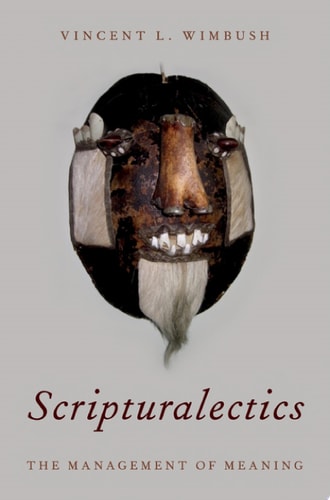
Scripturalectics: The Management of Meaning
0
0
As an Amazon Associate and affiliate partner, Menrva Books earns from qualifying purchases. Learn more
Author Description
In this book,Vincent Wimbush seeks to problematize what we call "scriptures," a word first used to refer simply to "things written," the registration of basic information. In the modern world the word came to be associated almost exclusively with the center- and power-defining "sacred" texts of "world religions." Wimbush argues that this narrowing of the valence of the term was a decisive development for western culture. His purpose is to reconsider the initially broad and politically charged use of the term. "Scriptures" are excavated not merely as texts to be read but understood as discourse: as mimetic rituals and practices, as ideologically-charged orientations to and prescribed behaviors in the world, as structures of relationships and social formations, as forms of communication. Wimbush is naming and constructing a new transdisciplinary critical project, which uses the historical and modern experiences of the Black Atlantic as resources for framing, categorization, and analysis. Using Chinua Achebe's novel Things Fall Apart as a touchstone, each chapter offers a close reading and analysis of a representative moment in the formation of the Black Atlantic, regarded as part of a history of modern human consciousness and conscientization. Such a history, Wimbush says, is reflected in the major turns in what he calls scripturalectics, part of the construction of the modern world, defined as efforts to manage or control knowledge and meaning.
Menrva's Summary
THE THESIS
Vincent L. Wimbush investigates the historical and political narrowing of the term 'scripture' to argue that it functions as a mechanism for the management and control of knowledge and meaning. Drawing on his expertise in religious studies and critical theory, Wimbush proposes a transdisciplinary project titled 'scripturalectics.' He utilizes the Black Atlantic experience as a primary analytical framework to demonstrate how texts operate as mimetic rituals and social structures rather than static documents.
THE SCOPE MAP
What You Will Find
- A redefinition of 'scripture' as discourse and social practice
- Analysis of the Black Atlantic as a site of modern consciousness formation
- A critical reading of Chinua Achebe's 'Things Fall Apart' as a foundational touchstone
- Theoretical exploration of how power defines sacred texts
Scope Limits
- The text does not provide a comprehensive history of all world religions
- It does not function as a traditional theological commentary on specific religious canons
THE AUTHORITY PERSPECTIVE
Scholars in the field of religious studies and critical theory recognize this work as a significant intervention in how we categorize and analyze sacred texts. Readers frequently note the academic density of the prose, which requires a strong background in critical theory to fully engage with the author's complex arguments.
Page Count:
200
Publication Date:
2017-01-01
Publisher:
Oxford University Press
ISBN-10:
0190670282
ISBN-13:
9780190670283
Philosophy
Religion
Bibles
Black studies
Critical Theory
Sociology of Religion
Community Tags
Similar Books