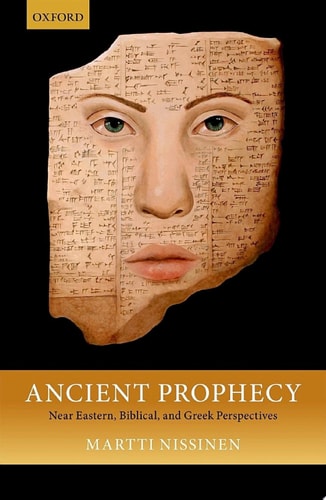
Ancient Prophecy: Near Eastern, Biblical, and Greek Perspectives
0
0
As an Amazon Associate and affiliate partner, Menrva Books earns from qualifying purchases. Learn more
Author Description
This is an open access title available under the terms of a CC BY-NC-ND 4.0 International licence. It is free to read at Oxford Scholarship Online and offered as a free PDF download from OUP and selected open access locations. Ancient Prophecy: Near Eastern, Biblical, and Greek Perspectives is the first monograph-length comparative study on prophetic divination in ancient Near Eastern, biblical, and Greek sources. Prophecy is one of the ways humans have believed to become conversant with what is believed to be superhuman knowledge. The prophetic process of communication involves the prophet, her/his audience, and the deity from whom the message allegedly comes from. Martti Nissinen introduces a wealth of ancient sources documenting the prophetic phenomenon around the ancient Eastern Mediterranean, whether cuneiform tablets from Mesopotamia, the Hebrew Bible, Greek inscriptions, or ancient historians. Nissinen provides an up-to-date presentation of textual sources, the number of which has increased substantially in recent times. In addition, the study includes four analytical comparative chapters. The first demonstrates the altered state of consciousness to be one of the central characteristics of the prophets' public behavior. The second discusses the prophets' affiliation with temples, which are the typical venues of the prophetic performance. The third delves into the relationship between prophets and kings, which can be both critical and supportive. The fourth shows gender-inclusiveness to be one of the peculiar features of the prophetic agency, which could be executed by women, men, and genderless persons as well. The ways prophetic divination manifests itself in ancient sources depend not only on the socio-religious position of the prophets in a given society, but also on the genre and purpose of the sources. Nissinen contends that, even though the view of the ancient prophetic landscape is restricted by the fragmentary and secondary nature of the sources, it i
Menrva's Summary
THE THESIS
This work investigates the nature and function of prophetic divination across ancient Near Eastern, biblical, and Greek cultures to determine how these societies accessed perceived superhuman knowledge. Martti Nissinen, a scholar of ancient Near Eastern religions, utilizes a vast array of primary textual sources—including cuneiform tablets, biblical manuscripts, and Greek inscriptions—to construct a comparative framework. He argues that despite the fragmentary nature of the evidence, prophetic agency functioned through consistent social and religious structures across these diverse Mediterranean civilizations.
THE SCOPE MAP
What You Will Find
- Comparative analysis of prophetic behavior in Mesopotamia, the Levant, and Greece.
- Examination of the role of altered states of consciousness in prophetic performance.
- Analysis of the institutional relationship between prophets, temple authorities, and political rulers.
- Discussion of gender inclusivity within the prophetic office.
Scope Limits
- The study is constrained by the secondary and fragmentary nature of the surviving ancient source material.
- It does not provide an exhaustive history of every individual prophetic figure, focusing instead on the phenomenon of prophecy as a social process.
THE AUTHORITY PERSPECTIVE
Scholars recognize this monograph as a foundational comparative study that bridges the gap between Near Eastern and Classical studies. The text is noted for its academic rigor and its ability to synthesize a wide range of disparate primary sources into a coherent analytical framework.
Page Count:
465
Publication Date:
2017-01-01
Publisher:
OUP Oxford
ISBN-10:
0192535986
ISBN-13:
9780192535986
Religion
History
Prophets
Near East
Bibles
Divination
Middle East
Prophecy
Sociology of Religion
Social Life
Community Tags
Other Editions(2)
Similar Books











Reader Comments
Share Your Thoughts
No comments yet. Be the first to share your thoughts!