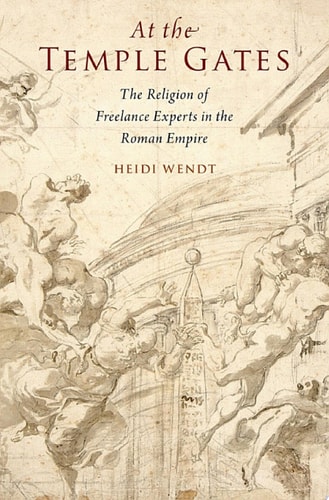
At the Temple Gates: The Religion of Freelance Experts in the Roman Empire
0
0
As an Amazon Associate and affiliate partner, Menrva Books earns from qualifying purchases. Learn more
Author Description
In his sixth satire, Juvenal speculates about how Roman wives busy themselves while their husbands are away, namely, by entertaining a revolving door of exotic visitors who include a eunuch of the eastern goddess Bellona, an impersonator of Egyptian Anubis, a Judean priestess, and Chaldean astrologers. From these self-proclaimed religious specialists women solicit services ranging from dream interpretation to the coercion of lovers. Juvenal's catalogue suggests the popularity of such "freelance" experts at the turn of the second century and their familiarity to his audience, whom he could expect to get the joke. Heidi Wendt investigates the backdrop of this enthusiasm for the religion of freelance experts by examining their rise during the first two centuries of the Roman Empire. Unlike civic priests and temple personnel, freelance experts had to generate their own authority and legitimacy, often through demonstrations of skill and learning in the streets, in marketplaces, and at the temple gates, among other locations in the Roman world. Wendt argues that these professionals participated in a highly competitive form of religious activity that intersected with multiple areas of specialty, particularly philosophy and medicine. Over the course of the imperial period freelance experts grew increasingly influential, more diverse with respect to their skills and methods, and more assorted in the ethnic coding of their practices. Wendt argues that this context engendered many of the innovative forms of religion that flourished in the second and third centuries, including phenomena linked with Persian Mithras, the Egyptian gods, and the Judean Christ.The evidence for freelance experts in religion is abundant, but scholars of ancient Mediterranean religion have only recently begun to appreciate their impact on the empire's changing religious landscape. At the Temple Gates integrates studies of Judaism, Christianity, mystery cults, astrology, magic, and philosophy to paint a
Menrva's Summary
THE THESIS
How did freelance religious experts in the Roman Empire establish authority and influence the development of new religious movements during the first two centuries? Heidi Wendt, a scholar of ancient Mediterranean religion, examines the rise of independent religious practitioners who operated outside the traditional civic priesthoods. By analyzing literary, historical, and archaeological evidence, she argues that these figures utilized competitive demonstrations of skill and learning to build legitimacy, ultimately shaping the religious landscape of the imperial period.
THE SCOPE MAP
What You Will Find
- Analysis of religious competition between freelance experts, philosophers, and medical practitioners.
- Examination of the social and economic mechanisms used by independent experts to gain public trust.
- Investigation into the origins of mystery cults and early Christian movements.
Scope Limits
- The study focuses primarily on the first two centuries of the Roman Empire.
- It does not provide an exhaustive catalogue of every individual religious sect present in the Mediterranean.
THE AUTHORITY PERSPECTIVE
Scholars recognize this work as a significant contribution to the study of religious pluralism in the ancient world. Readers frequently note the academic rigor and the clarity with which the author connects disparate religious phenomena to broader social trends.
Page Count:
274
Publication Date:
2016-01-01
Publisher:
Oxford University Press
ISBN-10:
019062759X
ISBN-13:
9780190627591
Classics
History
Religion
Sociology of Religion
Roman Empire
Rome religion
Ancient History
Bibles
Community Tags
Similar Books