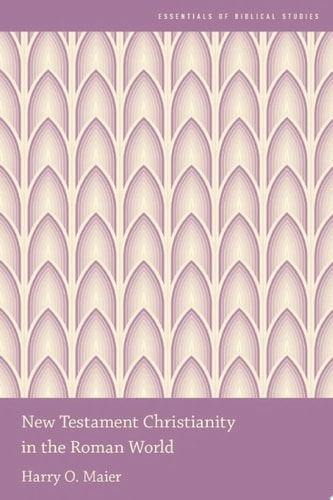
New Testament Christianity in the Roman World (Essentials of Biblical Studies)
0
0
As an Amazon Associate and affiliate partner, Menrva Books earns from qualifying purchases. Learn more
Author Description
What did it mean to be a Christian in the Roman Empire? In one of the inaugural titles of Oxford's new Essentials in Biblical Studies series, Harry O. Maier considers the multilayered social contexts that shaped the authors and audiences of the New Testament. Beginning with the cosmos and the gods, Maier presents concentric realms of influence on the new religious movement of Christ-followers. The next is that of the empire itself and the sway the cult of the emperor held over believers of a single deity. Within the empire, early Christianity developed mostly in cities, the shape of which often influenced the form of belief. The family stood as the social unit in which daily expression of belief was most clearly on view and, finally, Maier examines the role of personal and individual adherence to the religion in the shaping of the Christian experience in the Roman world. In all of these various realms, concepts of sacrifice, belief, patronage, poverty, Jewishness, integration into city life, and the social constitution of identity are explored as important facets of early Christianity as a lived religion. Maier encourages readers to think of early Christianity not simply as an abstract and disconnected set of beliefs and practices, but as made up of a host of social interactions and pluralisms. Religion thus ceases to exist as a single identity, and acts instead as a sphere in which myriad identities co-exist.
Menrva's Summary
THE THESIS
This work investigates how the social, political, and cultural structures of the Roman Empire shaped the development and lived experience of early Christianity. Harry O. Maier, a scholar of early Christian history, utilizes a concentric model to analyze how external forces—ranging from the cosmic order to urban life and family dynamics—influenced the formation of Christian identity. By moving beyond abstract theology, the author argues that early Christianity functioned as a complex sphere of pluralistic social interactions rather than a monolithic religious movement.
THE SCOPE MAP
What You Will Find
- Analysis of the influence of the imperial cult and Roman political structures on early believers.
- Examination of urban environments and their role in shaping religious practice.
- Exploration of the family unit as a primary site for the daily expression of faith.
- Discussion of key social concepts including patronage, poverty, and Jewish identity.
Scope Limits
- The text does not provide a comprehensive theological history of the New Testament texts.
- The analysis focuses primarily on social and cultural contexts rather than detailed ecclesiastical or institutional history.
THE AUTHORITY PERSPECTIVE
Scholars and students frequently identify this text as a clear, accessible introduction to the social world of the New Testament. Experts highlight the author's effective use of a concentric framework to organize complex historical data for a general academic audience.
Page Count:
260
Publication Date:
2018-01-01
Publisher:
Oxford University Press
ISBN-10:
019026442X
ISBN-13:
9780190264420
Religion
History
Roman Empire
Ancient History
Christianity
Bibles
Community Tags
Similar Books