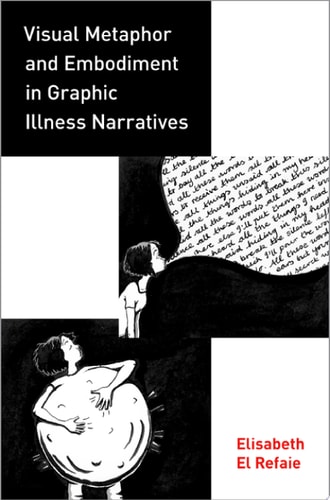
Visual Metaphor and Embodiment in Graphic Illness Narratives
0
0
As an Amazon Associate and affiliate partner, Menrva Books earns from qualifying purchases. Learn more
Author Description
Metaphors help us understand abstract concepts, emotions, and social relations through the concrete experience of our own bodies. Conceptual Metaphor Theory (CMT), which dominates the field of contemporary metaphor studies, is centered on this claim. According to this theory, correlations in the way the world is perceived in early childhood (e.g., happy/good is up, understanding is seeing) persist in our conceptual system, influencing our thoughts throughout life at a mostly unconscious level.What happens, though, when ordinary embodied experience is disrupted by illness? In this book, Elisabeth El Refaie explores how metaphors change according to our body's alteration due to disease. She analyzes visual metaphor in thirty-five graphic illness narratives (book-length stories about disease in the comics medium), re-examining embodiment in traditional CMT and proposing the notion of "dynamic embodiment." Building on recent strands of research within CMT and engaging relevant concepts from phenomenology, psychology, semiotics, and media studies, El Refaie demonstrates how the experience of our own bodies is constantly adjusting to changes in our individual states of health, socio-cultural practices, and the modes and media by which we communicate. This fundamentally interdisciplinary work also proposes a novel classification system of visual metaphor, based on a three-way distinction between pictorial, spatial, and stylistic metaphors. This approach will enable readers to advance knowledge and understanding of phenomena involved in shaping our everyday thoughts, interactions, and behavior.
Menrva's Summary
THE THESIS
This book investigates how the experience of illness disrupts and reshapes the conceptual metaphors that structure human thought and embodied perception. Elisabeth El Refaie, a scholar in the field of visual communication, utilizes Conceptual Metaphor Theory (CMT) as a foundation to analyze how graphic illness narratives represent the altered body. By integrating phenomenology, psychology, and semiotics, she argues for a framework of 'dynamic embodiment' that accounts for the constant adjustment of human perception in response to disease and socio-cultural shifts.
THE SCOPE MAP
What You Will Find
- Analysis of thirty-five distinct graphic illness narratives.
- A novel classification system for visual metaphors categorized into pictorial, spatial, and stylistic types.
- Theoretical synthesis of Conceptual Metaphor Theory with media studies and phenomenology.
Scope Limits
- The analysis is primarily restricted to the medium of book-length comics and graphic narratives.
- The study does not provide a comprehensive clinical guide to disease management, focusing instead on the semiotic and cognitive representation of illness.
THE AUTHORITY PERSPECTIVE
Scholars in the fields of comics studies and the health humanities recognize this work as a significant contribution to the understanding of visual rhetoric in medical narratives. Readers frequently note the academic density of the prose, which serves as a rigorous framework for analyzing how visual media communicates the subjective experience of bodily change.
Page Count:
240
Publication Date:
2019-01-10
Publisher:
Oxford University Press
ISBN-10:
0190678178
ISBN-13:
9780190678173
Comics Studies
Cognitive Linguistics
Themes motives
Semiotics
Graphic Novels
Literary Criticism
Health Humanities
Community Tags
Other Editions(3)

Similar Books








Reader Comments
Share Your Thoughts
No comments yet. Be the first to share your thoughts!