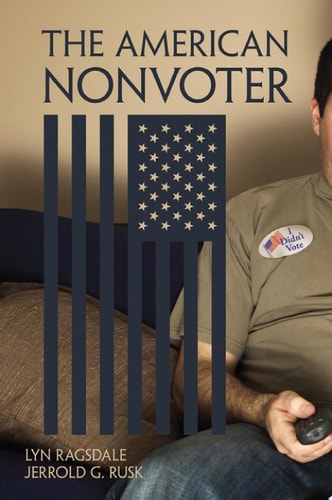
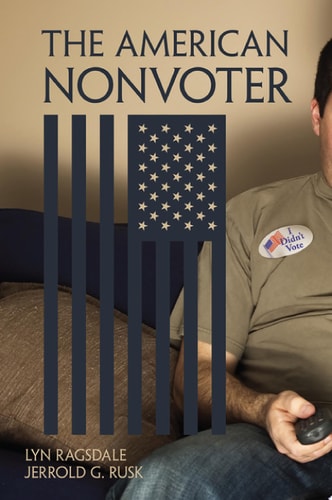
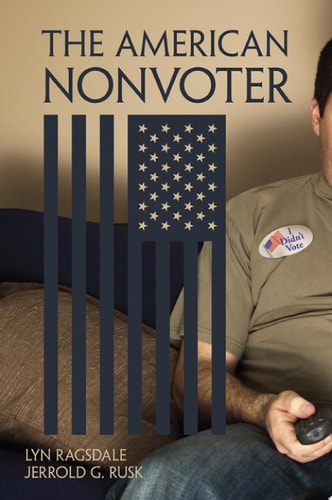
The American Nonvoter
0
0
As an Amazon Associate and affiliate partner, Menrva Books earns from qualifying purchases. Learn more
Author Description
A diverse body of research exists to explain why eligible voters don't go to the polls on election day. Theories span from the psychological (nonvoters have limited emotional engagement with politics and therefore lack motivation), to the social (politics is inherently social and nonvoters have limited networks), and the personal (nonvoters tend to be young, less educated, poor, and highly mobile). Other scholars suggest that people don't vote because campaigns are uninspiring. This book poses a new theory: uncertainty about the national context at the time of the election. During times of national crisis, when uncertainty is high, citizens are motivated to sort through information about each candidate to figure out which would best mitigate their uncertainty. When external uncertainty is low, however, citizens spend less time learning about candidates and are equally unmotivated to vote.The American Nonvoter examines how uncertainty regarding changing economic conditions, dramatic national events, and U.S. international interventions influences people's decisions whether to vote or not. Using rigorous statistical tools and rich historical stories, Lyn Ragsdale and Jerrold G. Rusk test this theory on aggregate nonvoting patterns in the United States across presidential and midterm elections from 1920 to 2012. The authors also challenge the stereotype of nonvoters as poor, uneducated and apathetic. Instead, the book shows that nonvoters are, by and large, as politically knowledgeable as voters, but see no difference between candidates or view them negatively.
Menrva's Summary
THE THESIS
This book investigates the core question of why eligible citizens choose not to participate in American elections by proposing a new theory centered on national uncertainty. Authors Jerrold G. Rusk and Lyn Ragsdale, both established scholars in political science, utilize a combination of historical analysis and statistical modeling to challenge traditional demographic explanations of nonvoting. They argue that voter turnout is primarily driven by the level of external uncertainty regarding economic conditions and national events rather than individual apathy or socioeconomic status.
THE SCOPE MAP
What You Will Find
- A longitudinal analysis of U.S. presidential and midterm elections from 1920 to 2012.
- A theoretical framework linking national crisis and uncertainty to voter motivation.
- Statistical evidence comparing the political knowledge of voters versus nonvoters.
Scope Limits
- The study focuses primarily on national-level elections and does not provide an in-depth analysis of local or municipal voting patterns.
- The research does not address the impact of modern digital-era social media algorithms on voter behavior post-2012.
THE AUTHORITY PERSPECTIVE
Experts recognize this work as a significant contribution to the study of electoral behavior that successfully challenges long-standing stereotypes about the American nonvoter. Readers frequently note the academic density of the prose, which is supported by rigorous quantitative data and historical context.
Page Count:
328
Publication Date:
2017-05-01
Publisher:
Oxford University Press
ISBN-10:
0190670711
ISBN-13:
9780190670719
History
American Politics
Elections
Voting
Sociology
Community Tags
Other Editions(3)
Similar Books







Reader Comments
Share Your Thoughts
No comments yet. Be the first to share your thoughts!