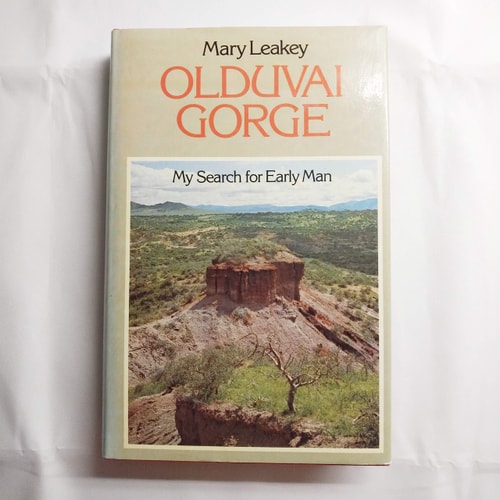
Olduvai Gorge: My Search for Early Man
0
0
As an Amazon Associate and affiliate partner, Menrva Books earns from qualifying purchases. Learn more
Author Description
Olduvai Groge is a valley in the Serengeti Plains at the western margin of the Eastern Rift Valley in northern Tanzania. The formations discussed in this volume, Beds I and II, were deposited in the Lower and Middle Pleistocene and have yielded large quantities of the remains of early man, in the form of bones and stone tools and evidence of the environment in which they lived. Bed I, in which remains of Australopithecus boisei and Homo habilis have been found, is firmly dated between 1.9 million years for the lowest level and 1.65 million years for a level below the top. This third volume describes the excavations. In Part I, starting with the lowest levels and devoting a chapter to each main level, Dr Leakey describes the actual process of excavation and the finding of the principal remains. In Part II, Dr Leakey describes the circumstances of the discovery of the hominid skeletal remains. These range from purposive excavation to accidental discovery while collecting small stones for mixing in concrete. Finally, mammalian bones, as tools and as food remains are discussed.
Menrva's Summary
THE THESIS
This volume investigates the geological and archaeological significance of Olduvai Gorge, specifically focusing on the findings within Beds I and II to reconstruct the environment and life of early hominids. Dr. Mary Leakey, a preeminent paleoanthropologist, utilizes her extensive field experience and meticulous excavation records to document the recovery of stone tools and skeletal remains. The work provides a rigorous framework for understanding the Lower and Middle Pleistocene strata, grounding theoretical discussions in the physical reality of the Tanzanian landscape.
THE SCOPE MAP
What You Will Find
- Detailed stratigraphic analysis of Beds I and II in the Olduvai Gorge.
- Documentation of the discovery process for Australopithecus boisei and Homo habilis remains.
- Analysis of mammalian bone assemblages as evidence of tool use and dietary patterns.
- Methodological insights into both systematic excavation and opportunistic discovery in field archaeology.
THE AUTHORITY PERSPECTIVE
This text serves as a foundational reference for specialists and students of human evolution, offering a dense, empirical record of one of the most important archaeological sites in history. The clinical, observational tone reflects the author's commitment to primary data, establishing the work as a standard for field reporting in paleoanthropology.
Page Count:
187
Publication Date:
1979-01-01
Publisher:
Collins
ISBN-10:
0002116138
ISBN-13:
9780002116138
History
Science
Africa
Paleontology
Anthropology
Hominids
Women biography
Archaeology
Leakey Mary D 1913-
Community Tags
Similar Books