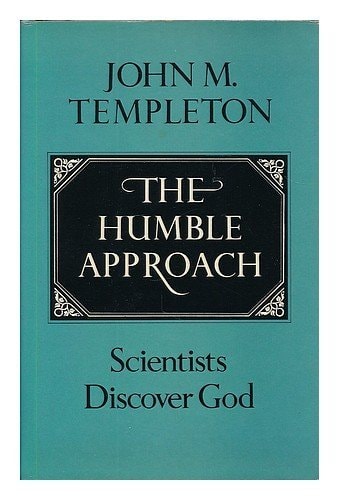
Humble Approach: Scientists Discover God
0
0
As an Amazon Associate and affiliate partner, Menrva Books earns from qualifying purchases. Learn more
Author Description
For generations it has been assumed that the discoveries of science, especially in the nineteenth and twentieth centuries, tended to refute the beliefs of religious people and established religions, and challenged the very existence of God. Templeton makes a striking argument for just the opposite point of view. He goes to the writings of many of the world's leading scientific thinkers - as diverse in background as Albert Einstein and Teilhard de Chardin - and discovers them in awe of the universe, perceiving the hand of Divine mystery at work. Templeton believes that the best way to know God is through a reverential, open, humble approach. He presents this humble approach as the one that many of the most distinguished scientists have come to in their quest for knowledge and meaning.
Menrva's Summary
THE THESIS
This work investigates the core question of whether scientific advancement inherently contradicts religious belief or if it can serve as a conduit for understanding the Divine. Sir John M. Templeton, a renowned investor and philanthropist, draws upon his extensive engagement with scientific thought to argue that the pursuit of knowledge often leads to a sense of awe and spiritual humility. By synthesizing the perspectives of prominent thinkers, he posits that a reverential approach to discovery reveals a universe defined by mystery rather than purely materialistic mechanisms.
THE SCOPE MAP
What You Will Find
- Philosophical reflections on the intersection of modern physics and theology
- Biographical insights into the spiritual leanings of figures like Albert Einstein and Teilhard de Chardin
- A framework for adopting a humble, open-minded methodology in scientific inquiry
- Arguments challenging the historical assumption of an inevitable conflict between science and religion
THE AUTHORITY PERSPECTIVE
The text provides a bridge between empirical inquiry and metaphysical reflection, framing the scientific process as a form of spiritual exploration. Its focus on the personal testimonies of high-level thinkers suggests an accessible, albeit intellectually dense, exploration of the limits of human knowledge.
Page Count:
224
Publication Date:
1981-01-01
Publisher:
Collins
ISBN-10:
0002113988
ISBN-13:
9780002113984
Philosophy
Spirituality
Religion
Science
Theology
Humility
Community Tags
Similar Books