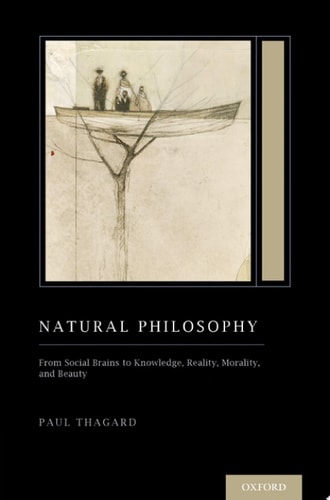
Natural Philosophy
0
0
As an Amazon Associate and affiliate partner, Menrva Books earns from qualifying purchases. Learn more
Author Description
Paul Thagard Uses New Accounts Of Brain Mechanisms And Social Interactions To Forge Theories Of Mind, Knowledge, Reality, Morality, Justice, Meaning, And The Arts. Natural Philosophy Brings New Methods For Analyzing Concepts, Understanding Values, And Achieving Coherence. It Shows How To Unify The Humanities With The Cognitive And Social Sciences. How Can People Know What Is Real And Strive To Make The World Better? Philosophy Is The Attempt To Answer General Questions About The Nature Of Knowledge, Reality, And Values. Natural Philosophy Pursues These Questions By Drawing Heavily On The Sciences And Finds No Room For Supernatural Entities Such As Souls, Gods, And Possible Worlds. It Provides Original Accounts Of The Traditional Branches Of Philosophy, Including Epistemology, Metaphysics, Ethics, And Aesthetics. Rather Than Reducing The Humanities To The Sciences, This Book Displays Fertile Interconnections That Show That Philosophical Questions And Artistic Practices Can Be Much Better Understood By Considering How Human Brains Operate And Interact In Social Contexts. The Sciences And The Humanities Are Interdependent, Because Both The Natural And Social Sciences Cannot Avoid Questions About Methods And Values That Are Primarily The Province Of Philosophy. This Book Belongs To A Trio That Includes Brain-mind: From Neurons To Consciousness And Creativity And Mind-society: From Brains To Social Sciences And Professions. They Can Be Read Independently, But Together They Make Up A Treatise On Mind And Society That Provides A Unified And Comprehensive Treatment Of The Cognitive Sciences, Social Sciences, Professions, And Humanities.
Menrva's Summary
THE THESIS
How can human beings reconcile the pursuit of knowledge, reality, and values with a worldview grounded strictly in cognitive and social science? Paul Thagard, a prominent researcher in cognitive science and philosophy, argues that traditional philosophical inquiries—ranging from epistemology to aesthetics—must be re-evaluated through the lens of brain mechanisms and social interaction. By rejecting supernatural explanations, Thagard proposes a unified framework that bridges the gap between the humanities and the empirical sciences to address fundamental questions about human existence.
THE SCOPE MAP
What You Will Find
- A naturalistic approach to epistemology, metaphysics, ethics, and aesthetics.
- Theoretical models integrating neural mechanisms with social behavior.
- A methodology for analyzing concepts and values through cognitive coherence.
- An interdisciplinary argument for the interdependence of the humanities and the sciences.
Scope Limits
- The text explicitly excludes supernatural entities, such as souls, gods, or metaphysical possible worlds, from its analytical framework.
- It does not attempt to reduce the humanities to mere scientific data, but rather seeks to demonstrate their fertile interconnections.
THE AUTHORITY PERSPECTIVE
Experts recognize this work as a significant contribution to naturalistic philosophy, noting its ambitious attempt to synthesize disparate academic fields into a coherent treatise. Readers frequently observe that the prose is dense and requires a foundational understanding of cognitive science to fully grasp the author's arguments.
Page Count:
304
Publication Date:
2019-01-01
Publisher:
Oxford University Press
ISBN-10:
019068643X
ISBN-13:
9780190686437
Philosophy
Metaphysics
Ethics
Epistemology
Social Science
Aesthetics
Community Tags
Similar Books