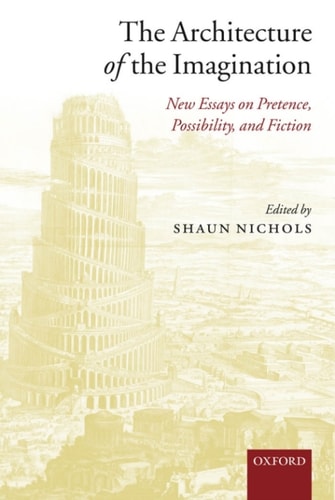
The Architecture of the Imagination: New Essays on Pretence, Possibility, and Fiction
0
0
As an Amazon Associate and affiliate partner, Menrva Books earns from qualifying purchases. Learn more
Author Description
This volume presents new essays on the propositional imagination by leading researchers. The propositional imagination—-the mental capacity we exploit when we imagine that everyone is colour-blind or that Hamlet is a procrastinator—-plays an essential role in philosophical theorizing, engaging with fiction, and indeed in everyday life. Yet only recently has there been a systematic attempt to give a cognitive account of the propositional imagination. These thirteen essays, specially written for the volume, capitalize on this recent work, extending the theoretical picture of the imagination and exploring the philosophical implications of cognitive accounts of the imagination. The book also investigates broader philosophical issues surrounding the propositional imagination. The first section addresses the nature of the imagination, its role in emotion production, and its sophistication manifestation in childhood. The essays in the second section focus on the nature of pretence and how pretence is implicated in adult communication. The third section addresses the problem of 'imaginative resistance', the striking fact that when we encounter morally repugnant assertions in fiction, we seem to resist imagining them and accepting them as fictionally true. In the final section, contributors explore the relation between imagining, conceiving, and judgements of possibility and impossibility. The Architecture of the Imagination will be an essential resource for the growing number of philosophers and psychologists studying the nature of the imagination and on its role in philosophy, aesthetics, and everyday life.
Menrva's Summary
THE THESIS
This volume investigates the cognitive mechanisms and philosophical implications of the propositional imagination, seeking to define how humans mentally simulate possibilities and engage with fictional scenarios. Shaun Nichols, a prominent researcher in cognitive science and philosophy, curates thirteen original essays that synthesize recent empirical findings with traditional philosophical inquiry. The collection aims to establish a systematic framework for understanding how the imagination functions in everyday life, aesthetic appreciation, and moral reasoning.
THE SCOPE MAP
What You Will Find
- Analysis of the nature of the imagination and its role in emotion production.
- Examination of the cognitive development of imagination in childhood.
- Investigation into the mechanics of pretence and its function in adult communication.
- Theoretical exploration of 'imaginative resistance' regarding morally repugnant fictional assertions.
- Discussions on the relationship between imagining, conceiving, and judgements of possibility.
Scope Limits
- The text focuses primarily on propositional imagination rather than sensory or visual imagery.
- It does not provide a comprehensive history of aesthetic theory, focusing instead on contemporary cognitive accounts.
THE AUTHORITY PERSPECTIVE
Experts identify this collection as a significant contribution to the intersection of philosophy and cognitive science, particularly for its focus on the mechanics of mental simulation. Readers frequently note the academic density of the prose, which is intended for researchers and advanced students in the fields of philosophy and psychology.
Page Count:
290
Publication Date:
2006-01-01
Publisher:
Clarendon Press
ISBN-10:
019153465X
ISBN-13:
9780191534652
Philosophy
Psychology
Aesthetics
Epistemology
English & College Success
English
Mind & Body
Linguistics
Community Tags
Similar Books