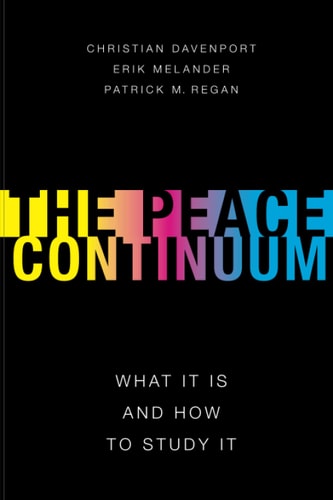
The Peace Continuum: What It Is and How to Study It
0
0
As an Amazon Associate and affiliate partner, Menrva Books earns from qualifying purchases. Learn more
Author Description
The idea of studying peace has gained considerable traction in the past few years after languishing in the shadows of conflict for decades but how should it be studied? The Peace Continuum offers a parallax view of how we think about peace and the complexities that surround the concept (i.e., the book explores the topic from different positions at the same time). Toward this end, we review existing literature and provide insights into how peace should be conceptualized - particularly as something more interesting than the absence of conflict. We provide an approach that can help scholars overcome what we see as the initial shock that comes with unpacking the 'zero' in the war-peace model of conflict studies. Additionally, we provide a framework for understanding how peace and conflict have/have not been related to one another in the literature. To reveal how the Peace Continuum could be applied, we put forward three alternative ways that peace could be studied. With this approach, the book is less trying to control the emerging peace research agenda than it is trying to assist in/encourage thinking about the topic that we all have some opinion on but that has yet to be measured and analyzed in a way comparable to political conflict and violence. Indeed, we attempt to help facilitate a veritable explosion of approaches and efforts to study peace.
Menrva's Summary
THE THESIS
This book investigates the methodological challenges of conceptualizing and measuring peace as a distinct phenomenon rather than merely the absence of conflict. Author Christian Davenport, a scholar in political science and conflict studies, critiques the traditional binary war-peace model. He proposes a 'peace continuum' framework to help researchers move beyond the 'zero' state of conflict and develop more nuanced, empirical approaches to studying peace within political science.
THE SCOPE MAP
What You Will Find
- A critical review of existing literature on peace and conflict studies.
- A theoretical framework for conceptualizing peace as a multi-dimensional variable.
- Three alternative methodological approaches for measuring and analyzing peace.
Scope Limits
- The text does not provide a single, definitive definition of peace.
- It does not offer a comprehensive history of global peace movements.
THE AUTHORITY PERSPECTIVE
Scholars in the field of peace and conflict studies view this work as a significant intervention in research methodology. Readers frequently note the academic density of the prose, which is intended primarily for researchers and graduate students seeking to formalize the study of peace.
Page Count:
240
Publication Date:
2018-07-19
Publisher:
Oxford University Press
ISBN-10:
019068013X
ISBN-13:
9780190680138
International relations
Peace studies
Conflict Resolution
Community Tags
Similar Books