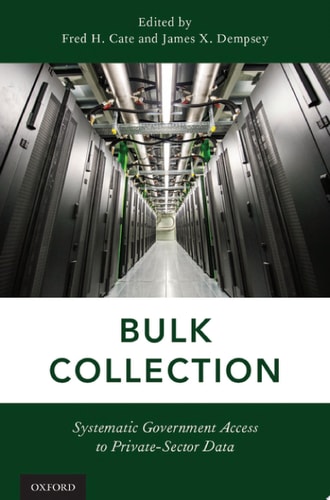
Bulk Collection: Systematic Government Access to Private-Sector Data
0
0
As an Amazon Associate and affiliate partner, Menrva Books earns from qualifying purchases. Learn more
Author Description
This is an open access title available under the terms of a CC BY-NC-ND 4.0 International licence. It is free to read at Oxford Scholarship Online and offered as a free PDF download from OUP and selected open access locations.This book is the culmination of nearly six years of research initiated by Fred Cate and Jim Dempsey to examine national practices and laws regarding systematic government access to personal information held by private-sector companies. Leading an effort sponsored by The Privacy Projects, they commissioned a series of country reports, asking national experts to uncover what they could about government demands on telecommunications providers and other private-sector companies to disclose bulk information about their customers. Their initial research found disturbing indications of systematic access in countries around the world. These data collection programs, often undertaken in the name of national security, were cloaked in secrecy and largely immune from oversight, posing serious threats to personal privacy. After the Snowden leaks confirmed these initial findings, the project morphed into something more ambitious: an effort to explore what should be the rules for government access to private-sector data, and how companies should respond to government demands for access.This book contains twelve updated country reports plus eleven analytic chapters that present descriptive and normative frameworks for assessing national surveillance laws, survey evolving international law and human rights principles applicable to government surveillance, and describe oversight mechanisms. It also explores the concept of accountability and the role of encryption in shaping the surveillance debate. Cate and Dempsey conclude by offering recommendations for both governments and industry.
Menrva's Summary
THE THESIS
This book investigates the legal, ethical, and procedural frameworks governing systematic government access to private-sector data across international jurisdictions. Fred H. Cate and James X. Dempsey, both experts in information privacy and national security law, synthesize six years of research initiated by The Privacy Projects. They argue that the lack of transparency and oversight in current surveillance practices necessitates a new normative framework to protect personal privacy while addressing national security requirements.
THE SCOPE MAP
What You Will Find
- Twelve detailed country reports analyzing national surveillance laws and practices.
- Eleven analytic chapters covering international human rights principles and oversight mechanisms.
- Discussions on the role of encryption and corporate accountability in the surveillance debate.
Scope Limits
- The text does not provide a comprehensive global survey of every nation, focusing instead on selected case studies.
- It does not offer technical manuals for implementing specific encryption technologies.
THE AUTHORITY PERSPECTIVE
Experts identify this work as a foundational resource for understanding the intersection of state surveillance and private-sector data protection. Readers frequently note the academic density of the prose and the rigor of the comparative legal analysis provided by the contributors.
Page Count:
504
Publication Date:
2017-10-06
Publisher:
Oxford University Press
ISBN-10:
0190685514
ISBN-13:
9780190685515
Technology
Law
Internet
Privacy
Human rights
Law And Legislation
Surveillance
Government Information
Professional Career & Trade
Community Tags
Similar Books