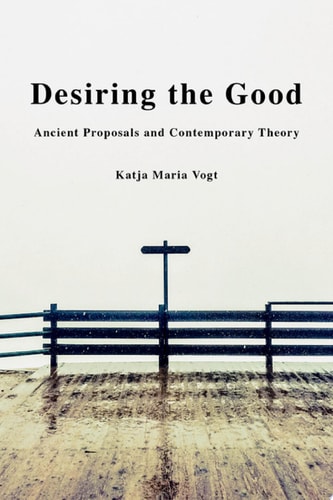
Desiring the Good: Ancient Proposals and Contemporary Theory
0
0
As an Amazon Associate and affiliate partner, Menrva Books earns from qualifying purchases. Learn more
Author Description
Desiring the Good defends a novel and distinctive approach in ethics that is inspired by ancient philosophy. Ethics, according to this approach, starts from one question and its most immediate answer: "what is the good for human beings?"--"a well-going human life." Ethics thus conceived is broader than moral philosophy. It includes a range of topics in psychology and metaphysics. Plato's Philebus is the ancestor of this approach. Its first premise, defended in Book I of Aristotle's Nicomachean Ethics, is that the final agential good is the good human life. Though Aristotle introduces this premise while analyzing human activities, it is absent from approaches in the theory of action that self-identify as Aristotelian. This absence, Vogt argues, is a deep and far-reaching mistake, one that can be traced back to Elizabeth Anscombe's influential proposals. And yet, the book is Anscombian in spirit. It engages with ancient texts in order to contribute to philosophy today, and it takes questions about the human mind to be prior to, and relevant to, substantive normative matters. In this spirit, Desiring the Good puts forward a new version of the Guise of the Good, namely that desire to have one's life go well shapes and sustains mid- and small-scale motivations. A theory of good human lives, it is argued, must make room for a plurality of good lives. Along these lines, the book lays out a non-relativist version of Protagoras's Measure Doctrine and defends a new kind of realism about good human lives.
Menrva's Summary
THE THESIS
This book investigates the fundamental question of what constitutes a good human life by bridging ancient philosophical frameworks with contemporary action theory. Katja Maria Vogt, a scholar of ancient philosophy, argues that modern ethics has drifted from the foundational Aristotelian premise that all human agency is directed toward the overarching goal of a well-going life. By critiquing the limitations of current neo-Aristotelian action theories, the author proposes a revised version of the Guise of the Good that integrates psychological and metaphysical dimensions into normative ethics.
THE SCOPE MAP
What You Will Find
- A critical analysis of Plato's Philebus and Aristotle's Nicomachean Ethics
- A re-evaluation of Elizabeth Anscombe's influence on modern action theory
- A proposed non-relativist interpretation of the Protagorean Measure Doctrine
- A defense of a new form of realism regarding the plurality of good human lives
Scope Limits
- The text does not provide a comprehensive history of all ancient ethical schools
- It does not offer a prescriptive manual for personal conduct or self-help
THE AUTHORITY PERSPECTIVE
Scholars and students of philosophy frequently note the academic density and rigorous analytical nature of the prose. Experts highlight this work as a significant contribution to the ongoing dialogue between classical antiquity and contemporary normative theory.
Page Count:
231
Publication Date:
2017-01-01
Publisher:
Oxford University Press
ISBN-10:
0190692499
ISBN-13:
9780190692490
Philosophy
Metaphysics
Good & Evil
History & Surveys
Ethics
Community Tags
Similar Books