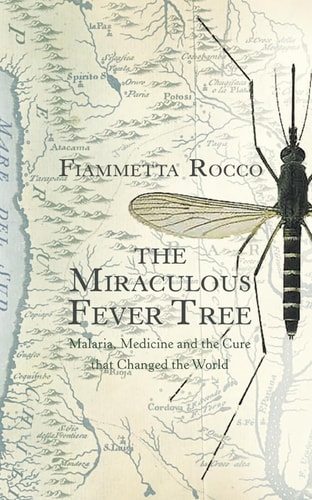
The Miraculous Fever-Tree: Malaria, Medicine and the Cure That Changed the World
0
0
As an Amazon Associate and affiliate partner, Menrva Books earns from qualifying purchases. Learn more
Author Description
Malaria, Medicine and the Cure that Changed the WorldIn the summer of 1623, ten cardinals and hundreds of their attendants, engaged in electing a new Pope, died from the 'mal'aria' or 'bad air' of the Roman marshes. Their choice, Pope Urban VIII, determined that a cure should be found for the fever that was the scourge of the Mediterranean, northern Europe and America, and in 1631 a young Jesuit apothecarist in Peru sent to the Old World a cure that had been found in the New – where the disease was unknown.The cure was quinine, an alkaloid made of the bitter red bark of the cinchona tree, which grows in the Andes. Both disease and cure have an extraordinary history. Malaria badly weakened the Roman Empire. It killed thousands of British troops fighting Napoleon during the Walcheren raid on Holland in 1809 and many soldiers on both sides of the American Civil War. It turned back many of the travellers who explored west Africa and brought the building of the Panama Canal to a standstill. When, after a thousand years, a cure was finally found, Europe's Protestants, among them Oliver Cromwell, who suffered badly from malaria, feared it was nothing more than a Popish poison. More than any previous medicine, though, quinine forced physicians to change their ideas about treating illness. Before long, it would change the face of Western medicine.Using fresh research from the Vatican and the Indian Archives in Seville, as well as hitherto undiscovered documents in Peru, Fiammetta Rocco describes the ravages of the disease, the quest of the three Englishmen who smuggled cinchona seeds out of South America, the way quinine opened the door to Western imperial adventure in Asia, Africa and beyond, and why, even today, quinine grown in the eastern Congo still saves so many people suffering from malaria.
Menrva's Summary
THE THESIS
This book investigates the historical impact of malaria on human civilization and the transformative role of quinine, the first effective cure derived from the cinchona tree, in shaping Western medicine and global exploration. Fiammetta Rocco, an experienced journalist and author, utilizes primary source research from the Vatican, the Indian Archives in Seville, and newly discovered documents from Peru to trace the development of this medicinal breakthrough. The narrative framework connects the biological reality of the disease with the geopolitical consequences of its treatment, arguing that the discovery of quinine fundamentally altered the trajectory of imperial expansion and medical practice.
THE SCOPE MAP
What You Will Find
- Historical analysis of malaria's impact on major events, including the Roman Empire, the American Civil War, and the construction of the Panama Canal.
- Detailed account of the Jesuit discovery of cinchona bark in the Andes and its subsequent introduction to Europe.
- Examination of the smuggling of cinchona seeds out of South America by British agents.
- Exploration of how quinine facilitated Western imperial expansion into Africa and Asia by mitigating the threat of tropical fevers.
THE AUTHORITY PERSPECTIVE
The text provides a dense, well-researched historical account that bridges the gap between medical science and geopolitical history. Its reliance on archival documentation suggests a rigorous approach suitable for readers interested in the intersection of colonial history and the evolution of pharmacology.
Page Count:
352
Publication Date:
2003-06-01
Publisher:
HarperCollins
ISBN-10:
0002572028
ISBN-13:
9780002572026
History
Biography
Non-Fiction
Science
Medicine history
Medicine
Medical
Crop husbandry
Community Tags
Similar Books