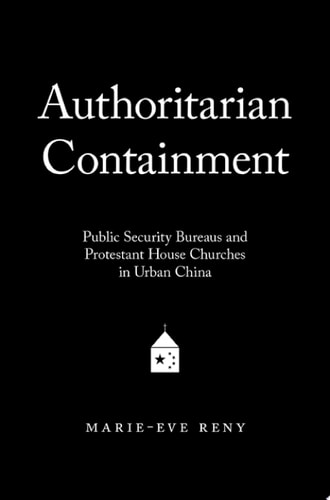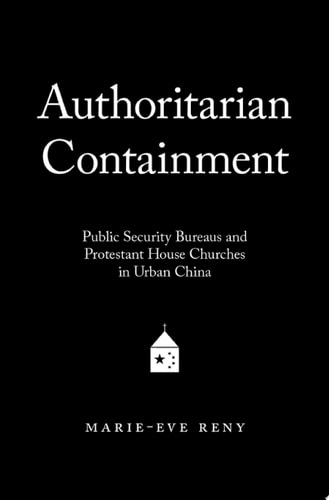
Authoritarian Containment: Public Security Bureaus and Protestant House Churches in Urban China
0
0
As an Amazon Associate and affiliate partner, Menrva Books earns from qualifying purchases. Learn more
Author Description
In Authoritarian Containment, Marie-Eve Reny examines why local public security bureaus tolerate unregistered Protestant churches in urban China--an officially atheist country where religious practice is controlled by the state--when the central government considers them illegal. She argues that local states tolerate these churches to contain the underground practice of Protestantism. Containment necessitates a bargain between informal religious organizations and the state. Even though they are not regulated, unregistered churches are allowed to operate conditionally, so long as church leaders keep a low profile, share information as needed with local authorities, and agree that the state will not grant them formal institutional recognition.Reny also considers authoritarian regimes other than China that employ a similar strategy to control informal religious communities. She focuses on two Middle East cases-President Sadat's control of the Muslim Brotherhood in 1970s Egypt and the Jordanian monarchy's containment of jihadi Salafists after 2006. By reducing the incentives for local religious leaders to politicize and inducing such leaders to willingly provide inside information, governments can avoid the heavy hand of coercion and forceful co-optation. Based on extensive fieldwork, Authoritarian Containment offers insight into the way authoritarian regimes neutralize underground religious leaders and discourage opposition to the state.
Menrva's Summary
THE THESIS
This book investigates the strategic logic behind why local public security bureaus in urban China tolerate unregistered Protestant house churches despite the central government's official stance of illegality. Marie-Eve Reny, a political scientist, utilizes extensive field research and comparative analysis to argue that local states employ a policy of containment. This framework suggests that authorities allow informal religious groups to operate under specific conditions—such as maintaining a low profile and sharing information—to prevent these organizations from becoming politicized or oppositional entities.
THE SCOPE MAP
What You Will Find
- Analysis of local state-church interactions in urban China
- Comparative study of religious control in 1970s Egypt and post-2006 Jordan
- Theoretical framework regarding the 'containment' of informal religious organizations
- Examination of the trade-offs between state coercion and informal co-optation
Scope Limits
- Does not provide a comprehensive history of Protestantism in China
- Does not focus on rural religious practices or state-sanctioned religious institutions
THE AUTHORITY PERSPECTIVE
Scholars and political analysts frequently cite this work for its nuanced understanding of how authoritarian regimes manage non-state actors through informal bargaining rather than overt repression. Experts highlight the book as a significant contribution to the study of state-society relations and the mechanics of authoritarian stability.
Page Count:
181
Publication Date:
2018-01-01
Publisher:
Oxford University Press
ISBN-10:
019069811X
ISBN-13:
9780190698119
Religion
Public Policy
Sociology
China Studies
Authoritarianism
Comparative Politics
Community Tags
Similar Books