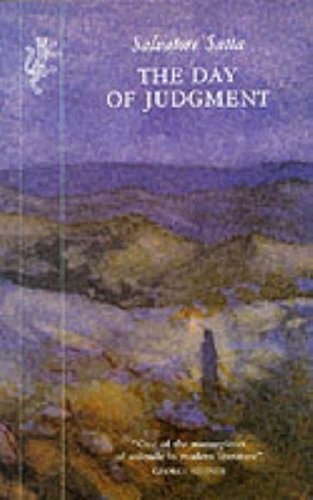
The Day of Judgment
0
0
As an Amazon Associate and affiliate partner, Menrva Books earns from qualifying purchases. Learn more
Author Description
Like Giuseppe Tomasi di Lampedusa's The Leopard, The Day of Judgment is a matchless poetic evocation of change and decay in an era now lost, unfolding the melancholy rhythms of the isolated Sardinian town of Nuoro at the turn of the century through the family fortunes of Don Sebastiano Sanna, its aristocrat and its notary. Through him, now an old man, we see the malarial plain and the olive groves, and the vineyards and orchards laboriously hacked out of the craggy slopes. And through his reflections on the town where he was born we see also Nuoro's other citizens, who come forward into the limelight for a page or two and leave in the mind what seems to be their whole life story. From this insignificant place and these negligible lives Satta created a sombre and tragic pageant, for in Nuoro the sin of having lived is such that the dead are restless, awaiting some day of judgment that will set them free at last from life.
Menrva's Summary
THE PULSE
The narrative centers on the slow, inevitable decline of a small Sardinian town at the turn of the century, viewed through the eyes of an aging notary who observes the fading fortunes of his neighbors. Don Sebastiano Sanna serves as the primary lens through which the reader encounters the inhabitants of Nuoro, a community defined by its isolation and the weight of its own history. The narrative structure is episodic and contemplative, moving between the personal history of the Sanna family and the fleeting, tragic glimpses of the town's other citizens. The prose operates under a heavy, melancholic atmosphere where the physical landscape of craggy slopes and malarial plains mirrors the internal stagnation of the characters who feel trapped by the act of living itself.
INSIDE THE PAGES
- Episodic character vignettes that capture the essence of individual lives in brief, poignant sketches.
- A focus on the passage of time and the decay of traditional social structures.
- First-person reflections that anchor the narrative in the perspective of an aging observer.
- A setting that functions as a character, with the geography of Nuoro dictating the rhythms of daily existence.
- Themes of existential weariness and the burden of memory.
- A somber, poetic prose style that emphasizes the gravity of the town's history.
- The integration of local Sardinian culture and social hierarchies into the narrative framework.
- A non-linear exploration of family fortunes and the decline of the local aristocracy.
THE COLLECTIVE ECHO
This work is frequently compared to the great Italian classics for its ability to transform a provincial setting into a universal meditation on human existence. Critics often highlight the author's capacity to imbue seemingly minor lives with a profound sense of tragedy and historical weight. The reception emphasizes the book's atmospheric density and the melancholic beauty of its prose, which captures a lost era with precision. Readers often note that the narrative demands patience, as it prioritizes internal reflection and character study over traditional plot momentum.
Page Count:
298
Publication Date:
1994-01-01
Publisher:
HarperCollins
ISBN-10:
0002711478
ISBN-13:
9780002711470
Literary Fiction
Historical Fiction
Family Saga
classic