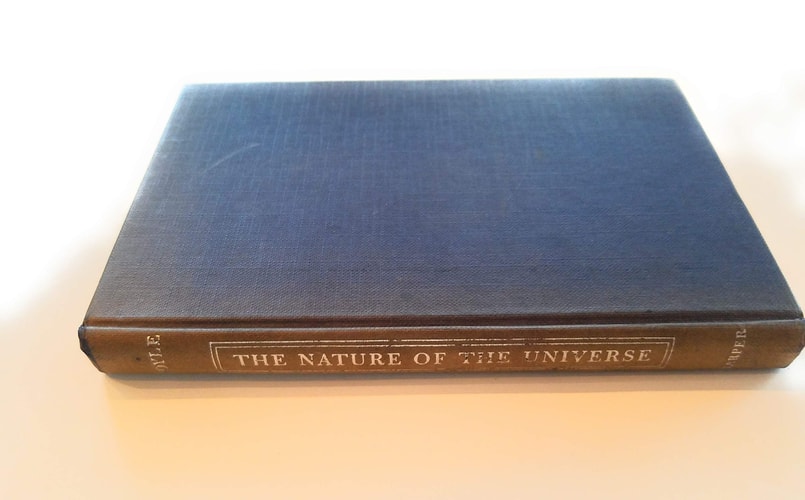
The Nature of the Universe.
0
0
As an Amazon Associate and affiliate partner, Menrva Books earns from qualifying purchases. Learn more
Author Description
Fred Hoyle had a series of radio programs in England printed in The Nature of the Universe. Sir Frederick "Fred" Hoyle FRS (24 June 1915 – 20 August 2001) was an English astronomer and mathematician noted primarily for his contribution to the theory of stellar nucleosynthesis and his often controversial stance on other cosmological and scientific matters—in particular his rejection of the "Big Bang" theory, a term originally coined by him on BBC radio. In addition to his work as an astronomer, Hoyle was a writer of science fiction, including a number of books co-written with his son Geoffrey Hoyle. Hoyle spent most of his working life at the Institute of Astronomy at Cambridge and served as its director for a number of years. He died in Bournemouth, England, after a series of strokes.
Menrva's Summary
THE THESIS
This work investigates the fundamental origins and ongoing evolution of the universe through the lens of steady-state cosmology. Fred Hoyle, a prominent astronomer and mathematician, utilizes his expertise in stellar nucleosynthesis to argue against the then-emerging Big Bang theory. He presents a framework where the universe is infinite in age and continuously creating matter to maintain a constant density over time.
THE SCOPE MAP
What You Will Find
- Explanations of stellar nucleosynthesis and the life cycles of stars
- Arguments for the steady-state theory of the universe
- Discussions on the formation of galaxies and planetary systems
- Philosophical reflections on the place of humanity within an infinite cosmos
Scope Limits
- The text does not incorporate later observational evidence that eventually favored the Big Bang model
- It does not provide a comprehensive history of all cosmological theories, focusing primarily on the author's specific perspective
THE AUTHORITY PERSPECTIVE
Experts recognize this text as a significant historical document that captures the intellectual climate of mid-20th-century cosmology. Readers frequently note the accessible, conversational tone of the prose, which originated from a series of radio broadcasts.
Page Count:
121
Publication Date:
1960-01-01
Publisher:
HarperCollins
ISBN-10:
0060028203
ISBN-13:
9780060028206
Non-Fiction
Science
SCIENCE Astronomy
Physics
Cosmology
Astronomy
Community Tags
Similar Books