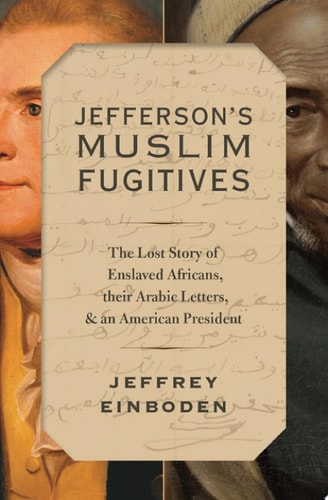
Jefferson's Muslim Fugitives: The Lost Story of Enslaved Africans, Their Arabic Letters, and an American President
0
0
As an Amazon Associate and affiliate partner, Menrva Books earns from qualifying purchases. Learn more
Author Description
On October 3, 1807, Thomas Jefferson was contacted by an unknown traveler urgently pleading for a private "interview" with the President, promising to disclose "a matter of momentous importance". By the next day, Jefferson held in his hands two astonishing manuscripts whose history has been lost for over two centuries. Authored by Muslims fleeing captivity in rural Kentucky, these documents delivered to the President in 1807 were penned by literate African slaves, and written entirely in Arabic.Jefferson's Muslim Fugitives reveals the untold story of two escaped West Africans in the American heartland whose Arabic writings reached a sitting U.S. President, prompting him to intervene on their behalf. Recounting a quest for emancipation that crosses borders of race, region and religion, Jeffrey Einboden unearths Arabic manuscripts that circulated among Jefferson and his prominent peers, including a document from 1780s Georgia which Einboden identifies as the earliest surviving example of Muslim slave authorship in the newly-formed United States. Revealing Jefferson's lifelong entanglements with slavery and Islam, Jefferson's Muslim Fugitives tracks the ascent of Arabic slave writings to the highest halls of U.S. power, while questioning why such vital legacies from the American past have been entirely forgotten.
Menrva's Summary
THE THESIS
This book investigates the historical significance of two Arabic manuscripts written by enslaved Muslims in 1807 and their direct correspondence with President Thomas Jefferson. Jeffrey Einboden, a scholar of comparative literature and religion, utilizes archival research and linguistic analysis to reconstruct the lives of these enslaved individuals. He argues that these documents represent a critical, overlooked intersection of American political power, the institution of slavery, and the presence of Islam in the early United States.
THE SCOPE MAP
What You Will Find
- Analysis of two specific Arabic manuscripts sent to Thomas Jefferson in 1807.
- Historical context regarding the presence of literate enslaved Muslims in the American South and Midwest.
- Examination of Jefferson's personal and political engagement with the authors of these documents.
- Identification of the earliest surviving example of Muslim slave authorship in the United States.
Scope Limits
- The book does not provide a comprehensive history of all enslaved Muslims in America.
- It does not attempt to resolve every ambiguity regarding the personal biographies of the two specific fugitives due to the scarcity of surviving records.
THE AUTHORITY PERSPECTIVE
Scholars and historians frequently praise this work for its meticulous archival recovery and its ability to challenge traditional narratives regarding the religious and intellectual lives of enslaved people. Readers often note the academic rigor of the prose, which effectively bridges the gap between literary analysis and historical documentation.
Page Count:
346
Publication Date:
2020-01-01
Publisher:
Oxford University Press
ISBN-10:
0190844493
ISBN-13:
9780190844493
History
Biography
Religion
Slavery
United States
Muslims
African Americans
American History
Slaves writings
Islam
African American
Minority Studies
Community Tags
Similar Books