
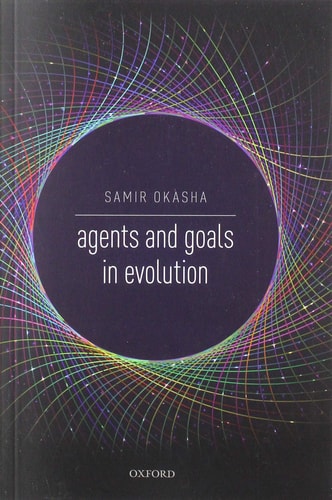
Agents and Goals in Evolution
0
0
As an Amazon Associate and affiliate partner, Menrva Books earns from qualifying purchases. Learn more
Author Description
Samir Okasha approaches evolutionary biology from a philosophical perspective in Agents and Goals in Evolution, analysing a mode of thinking in biology called agential thinking. He considers how the paradigm case involves treating an evolved organism as if it were an agent pursuing a goal, such as survival or reproduction, and seeing its phenotypic traits as strategies for achieving that goal or furthering its biological interests. As agential thinking deliberately transposes a set of concepts--goals, interests, strategies--from rational human agents and to the biological world more generally, Okasha's enquiry firstly looks at the justification for this: is it mere anthropomorphism, or does it play a genuine intellectual role in the science? From this central question, key points are considered such as: how do we identify the 'goal' that evolved organisms will behave as if they are trying to achieve? Can agential thinking ever be applied to groups rather than to individual organisms? And how does agential thinking relate to the controversies over fitness-maximization in evolutionary biology? In addition, Okasha examines the relation between the adaptive and the rational by considering whether organisms can validly be treated as agent-like. Should we expect their evolved behaviour to correspond with that of rational agents as codified in the theory of rational choice? If so, does this mean that the fitness-maximizing paradigm of the evolutionary biologist can be mapped directly to the utility-maximizing paradigm of the rational choice theorist? All of these important questions are engagingly raised and discussed at length.
Menrva's Summary
THE THESIS
This book investigates the intellectual legitimacy and scientific utility of 'agential thinking' in evolutionary biology, which treats organisms as goal-pursuing agents. Samir Okasha, a philosopher of science, examines whether describing biological traits as strategies for survival or reproduction is a valid scientific heuristic or merely an anthropomorphic projection. He constructs a framework to compare the fitness-maximization paradigm of evolutionary biology with the utility-maximization models found in rational choice theory.
THE SCOPE MAP
What You Will Find
- Analysis of the conceptual transposition of human agency onto biological systems
- Examination of fitness-maximization versus utility-maximization paradigms
- Discussion on the applicability of agential thinking to groups versus individuals
- Philosophical inquiry into the justification of teleological language in biology
Scope Limits
- Does not provide a comprehensive history of evolutionary theory
- Does not offer empirical biological research or new experimental data
THE AUTHORITY PERSPECTIVE
Experts recognize this work as a significant contribution to the philosophy of biology, noting its rigorous analytical approach to long-standing debates regarding adaptation. Readers frequently highlight the text's academic density and its success in bridging the gap between evolutionary biology and rational choice theory.
Page Count:
272
Publication Date:
2018-01-01
Publisher:
OUP Oxford
ISBN-10:
0192546732
ISBN-13:
9780192546739
Philosophy
Science
Evolution
Philosophy of
Mind & Body
Biology
Rational choice theory
Evolutionary Biology
Community Tags
Other Editions(4)
Similar Books
Reader Comments
Share Your Thoughts
No comments yet. Be the first to share your thoughts!