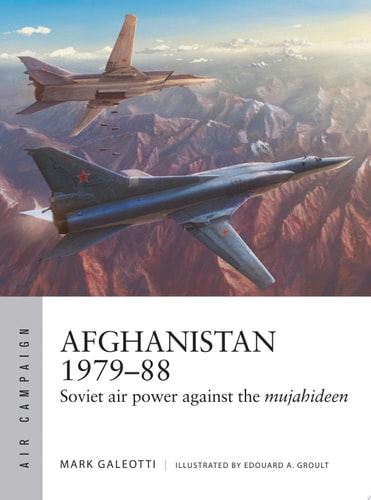
Afghanistan 1979–88
0
0
As an Amazon Associate and affiliate partner, Menrva Books earns from qualifying purchases. Learn more
Author Description
The first English-language book to examine the crucial part air power played in the Soviet-Afghan War. The Soviet Union's invasion of Afghanistan was fought as much in the air as on the ground. From the high-level bombing raids that blasted rebel-held mountain valleys, to the Mi-24 helicopter gunships and Su-25 jets that accompanied every substantial army operation, Soviet control of the air was a crucial battlefield asset. Vital to every aspect of its operations, Mi-8 helicopters ferried supplies to remote mountain-top observation points and took the bodies of fallen soldiers on their last journey home in An12 'Black Tulips'. But this was not a wholly one-sided conflict. Even before the Afghan rebels began to acquire man-portable surface-to-air missiles such as the controversial US 'Stinger,' they aggressively and imaginatively adapted. They learnt new techniques of camouflage and deception, set up ambushes against low-level attacks, and even launched daring raids on airbases to destroy aircraft on the ground. Featuring information previously unknown in the West, such as the Soviets' combat-testing of Yak-38 'Forger' naval jump jets, Soviet-expert Mark Galeotti examines the rebel, Kabul government and the Soviet operation in Afghanistan, drawing deeply on Western and Russian sources, and including after-action analyses from the Soviet military. Using maps, battlescenes and detailed 'Bird's Eye Views', he paints a comprehensive picture of the air war and describes how, arguably, it was Soviet air power that made the difference between defeat for Moscow and the subsequent stalemate that they decided to disengage from.
Menrva's Summary
THE THESIS
The Soviet-Afghan War was significantly shaped by aerial combat, a crucial aspect often overshadowed by ground operations. This book examines the critical role of air power in the conflict from 1979 to 1988, detailing how Soviet air superiority was maintained through bombing raids, helicopter gunships, and jet fighters. It also explores the innovative tactics employed by Afghan rebels to counter these aerial threats, including camouflage, deception, and direct attacks on airbases. Drawing on both Western and Russian sources, the work provides a comprehensive picture of the air war and its impact on the conflict's outcome.
THE SCOPE MAP
- Detailed analysis of Soviet air power, including bombing raids, Mi-24 helicopter gunships, and Su-25 jets.
- Examination of the logistical and transport roles of Mi-8 helicopters and An-12 aircraft.
- Exploration of Afghan rebel tactics against air power, such as camouflage, deception, and ambushes.
- Information on the use of man-portable surface-to-air missiles by rebels.
- Inclusion of Soviet combat testing of Yak-38 'Forger' naval jump jets.
- Analysis of operations from the perspectives of the rebel, Kabul government, and Soviet forces.
- Use of maps, battlescenes, and 'Bird's Eye Views' to illustrate the air war.
THE AUTHORITY PERSPECTIVE
This book is presented as the first English-language examination of air power's role in the Soviet-Afghan War, drawing on extensive Western and Russian sources. The author, a Soviet-expert, aims to provide a comprehensive picture of the air war, including details previously unknown in the West. The work is structured to detail both Soviet operations and rebel counter-tactics, utilizing maps and detailed illustrations to support its analysis. It argues that Soviet air power was a decisive factor in the conflict's eventual stalemate.
Page Count:
96
Publication Date:
2023-02-16
Publisher:
Bloomsbury UK
ISBN-10:
1472850742
ISBN-13:
9781472850744
History
Non-Fiction
Afghanistan
Military History
Aviation History
Soviet Union
Community Tags
Similar Books