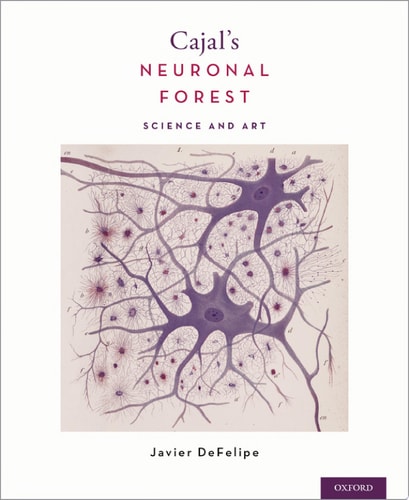
Cajal's Neuronal Forest: Science and Art
0
0
As an Amazon Associate and affiliate partner, Menrva Books earns from qualifying purchases. Learn more
Author Description
Cajal's Neuronal Forest: Science and Art continues the tradition set forth by its sister volume Cajal's Butterflies of the Soul (OUP, 2009). This new collection contains hundreds of beautiful rarely-seen-before figures produced throughout the nineteenth century and the beginning of the twentieth century by famed father-of-modern-neuroscience Santiago Ramón y Cajal (1852-1934) and his contemporaries. Cajal was captivated by the beautiful shapes of the cells of the nervous system. He and his fellow scientists saw neurons as trees and glial cells as bushes. Given their high density and arrangement, neurons and glial resembled a thick forest, a seemingly impenetrable terrain of interacting cells mediating cognition and behavior. In unraveling the mysteries of the brain, these researchers encountered an almost infinite number of cellular forms with an extraordinary beauty, which they could not help but put pen to paper, allowing them to discover a new artistic world- the neuronal forest- that gave free rein not only to their imagination, but to a new way of viewing the brain as well. This book has been divided into two parts. The first focuses on the scientific atmosphere in Cajal's times, on the history of the neuron, and the anatomical challenge posed in studying neuronal connections. It also delves into the artistic skills of Cajal and other important pioneers in neuroscience and how the neuronal forests have served as an unlimited source of artistic inspiration. The second consists of 275 original drawings by Cajal. All were published over the course of his scientific career and cover virtually all of his research fields of interest, including the spinal cord, the optic lobe and retina, cerebral cortex, and many other regions of the brain. Cajal's Neuronal Forest: Science and Art is a testament to the natural beauty found in science. Despite the common misconception that the drawings of Cajal and other scientists of the time are pieces of art, these drawings are in f
Menrva's Summary
THE THESIS
This volume investigates the intersection of scientific inquiry and aesthetic expression in the early development of modern neuroscience. Author Javier DeFelipe, a prominent neuroscientist, examines how Santiago Ramón y Cajal and his contemporaries utilized artistic documentation to map the complex architecture of the nervous system. The text argues that these anatomical drawings were not merely illustrative, but essential cognitive tools that allowed researchers to conceptualize the brain as a dense, organized forest of cellular structures.
THE SCOPE MAP
What You Will Find
- A historical analysis of the scientific climate in the late 19th and early 20th centuries.
- A collection of 275 original drawings by Santiago Ramón y Cajal covering the spinal cord, retina, and cerebral cortex.
- An examination of the anatomical challenges inherent in early neuronal mapping.
Scope Limits
- The book does not provide a comprehensive biography of Cajal's personal life outside of his scientific and artistic contributions.
- It does not offer modern digital imaging or contemporary neurobiological data beyond the historical context provided.
THE AUTHORITY PERSPECTIVE
Experts and historians of science frequently cite this work as a definitive visual archive of foundational neuroanatomical research. Readers note the high production quality of the illustrations and the scholarly rigor applied to the historical context of early neuroscience.
Page Count:
506
Publication Date:
2017-01-01
Publisher:
Oxford University Press
ISBN-10:
0190842857
ISBN-13:
9780190842857
Biography
Science
Medical
Neuroscience
Allied Health
Science History
Nervous System
Art History
Community Tags
Similar Books