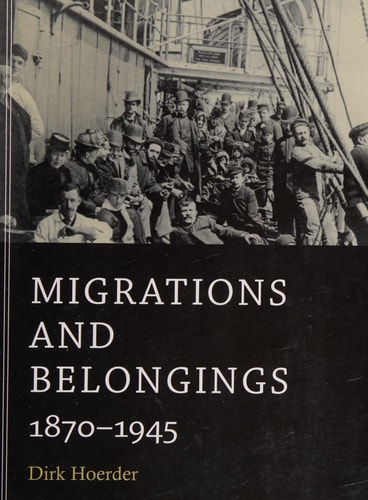
Migrations and Belongings 1870–1945
0
0
As an Amazon Associate and affiliate partner, Menrva Books earns from qualifying purchases. Learn more
Author Description
Toward the end of the nineteenth century, new railroads, ports, and steamships enabled people to travel faster and in greater numbers than ever before. Migrations and Belongings traces burgeoning population movements across several continents from 1870 to the end of World War II. This study explains the complex variables involved in global migrations and the processes of acculturation by which “belonging” takes shape. Dirk Hoerder emphasizes the migration systems that emerge when population clusters move between regions over long periods of time. Eschewing a Eurocentric perspective, he identifies five major systems in different parts of the world where men and women left areas with labor surpluses and swelled regions of urban and industrial growth. These include African slave migration from the 1440s to the 1870s; migration of free and indentured men and women across Asia; Russo-Siberian migration across parts of Asia, North America, and Europe; a North China–Manchurian migration; and an Atlantic system connecting Europe and the Americas. Migration, he shows, is both a critique of unsatisfactory conditions in one society and a contribution of human capital to another.
Menrva's Summary
THE THESIS
This book investigates the complex variables involved in global migrations and the processes of acculturation by which “belonging” takes shape from 1870 to the end of World War II. Dirk Hoerder, drawing on extensive research, emphasizes migration systems that emerge when population clusters move between regions over long periods. Eschewing a Eurocentric perspective, he identifies five major systems across continents where people left areas with labor surpluses and swelled regions of urban and industrial growth. The study considers the dynamic effects of departure, transit, and arrival, framing migration as both a critique of unsatisfactory conditions and a contribution of human capital.
THE SCOPE MAP
- Analysis of global population movements across several continents from 1870 to 1945.
- Explanation of complex variables in global migrations and acculturation processes.
- Identification of five major migration systems, including African slave migration, Asian migrations, Russo-Siberian migration, North China–Manchurian migration, and the Atlantic system.
- Examination of how migration encouraged population mixing and produced new social stratifications.
- A critique of the "container" view of states, focusing instead on the dynamic effects of migration.
- The argument that migration is both a critique of unsatisfactory conditions and a contribution of human capital.
THE AUTHORITY PERSPECTIVE
Dirk Hoerder's 'Migrations and Belongings 1870–1945' is recognized for its comprehensive and non-Eurocentric approach to understanding global population movements. The book is noted for its detailed analysis of migration systems and the intricate processes of acculturation. Scholars appreciate its examination of how migration shapes identity and social structures across continents. The work is considered a significant contribution to the study of historical migration patterns and their lasting impact.
Page Count:
230
Publication Date:
2014-04-21
Publisher:
Harvard University Press
ISBN-10:
0674281314
ISBN-13:
9780674281318
Non-Fiction
History
Global History
Social History
Migration Studies
Community Tags
Similar Books