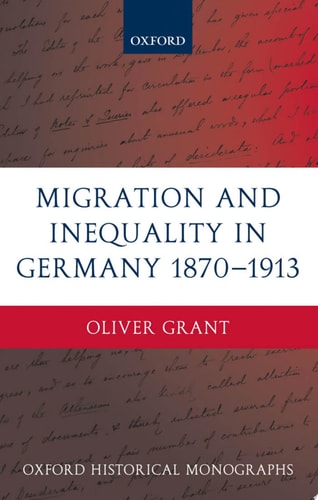
Migration and Inequality in Germany 1870-1913
0
0
As an Amazon Associate and affiliate partner, Menrva Books earns from qualifying purchases. Learn more
Author Description
Migration and Inequality in Germany 1870-1913 presents a new view of German history in the late nineteenth century. Dr Grant argues that many of the problems of Imperial Germany were temporary ones produced by the strain of rapid industrialisation. Drawing on the tools of development economics he argues that Germany passed through a labour surplus phase as desribed by the Lewis Model. This period came to an end around 1900, creating more favourable conditions for political reform and social reconciliation. But Germany's progress to full political and economic maturity was derailed at the outbreak of war in 1914. Dr Grant bases his argument on an analysis of the economic and demographic forces driving migration in nineteenth-century Germany. High rural-urban migration led to the rapid expansion of German cities. The main factors driving this were social and economic change in the countryside and the process of the demographic transition. The release of surplus labour onto urban labour markets held back wage increases and led to an increase in inequality. The German economy behaved in a way which seemed to bear out the predictions of Karl Marx and this contributed to the appeal of Marxist ideas and the rise of the social democratic vote. However, this was a temporary phase. The labour surplus period was largely over by 1900. The rise in inequality which had begun in the 1820s came to an end, and inequality began to fall. Contrary to received wisdom, Germany was not on the brink of a general socio-economic crisis in 1914; instead it was moving away from one. However, the political system failed to take advantage of this opportunity, and Germany's dependence on imported food and raw materials led to a strategic crisis which combined disastrously with internal political problems.
Menrva's Summary
THE THESIS
This book investigates whether the socio-economic tensions of Imperial Germany between 1870 and 1913 were structural failures or temporary consequences of rapid industrialization. Dr. Oliver Grant, an economic historian, utilizes the Lewis Model of development economics to analyze demographic and labor data from the late nineteenth century. He argues that Germany experienced a labor surplus phase that drove inequality and political radicalization, a trend that began to reverse around 1900 before being interrupted by the outbreak of World War I.
THE SCOPE MAP
What You Will Find
- Quantitative analysis of rural-to-urban migration patterns in Germany.
- Application of the Lewis Model to explain wage stagnation and inequality.
- Examination of the relationship between economic development and the rise of the Social Democratic Party.
Scope Limits
- The analysis concludes at the outbreak of war in 1914 and does not cover the wartime economy or the Weimar period.
- The focus remains primarily on economic and demographic drivers rather than detailed political biography.
THE AUTHORITY PERSPECTIVE
Scholars recognize this work as a rigorous application of development economics to historical German data, providing a counter-narrative to the idea that Germany was in a state of terminal socio-economic crisis by 1914. Readers frequently note the academic density of the prose and the author's reliance on statistical modeling to challenge established historical interpretations.
Page Count:
416
Publication Date:
2005-01-01
Publisher:
Clarendon Press
ISBN-10:
0191515353
ISBN-13:
9780191515354
Economics
History
European History
Migration Studies
Social History
German history
Community Tags
Similar Books